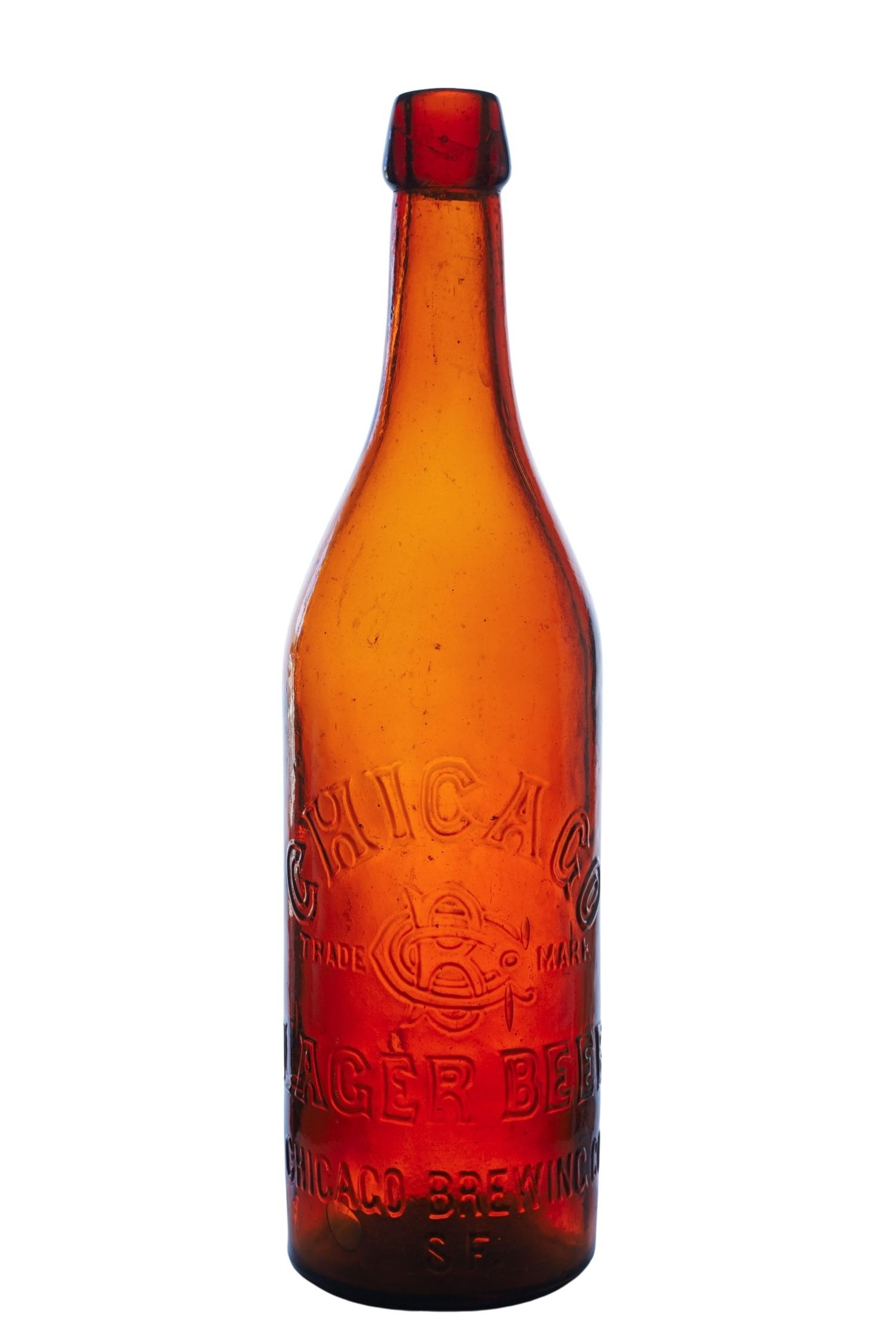
Chicago Lager Beer
Circa 1888–1895, applied top. The Chicago Brewery was one of San Francisco's longer-lived breweries, remaining in operation from at least the 1870s into the 1890s. This bottle dates from the later years of the applied–top era and features bold block-letter embossing characteristic of the period. While not as early or rare as some Western quart beers, nice examples are surprisingly difficult to find and remain desirable representatives of San Francisco's brewing history.
Description & Condition: Amber. Light interior brush marks and scattered exterior scuffs.
Min. Bid $50 - Est. $100–$200
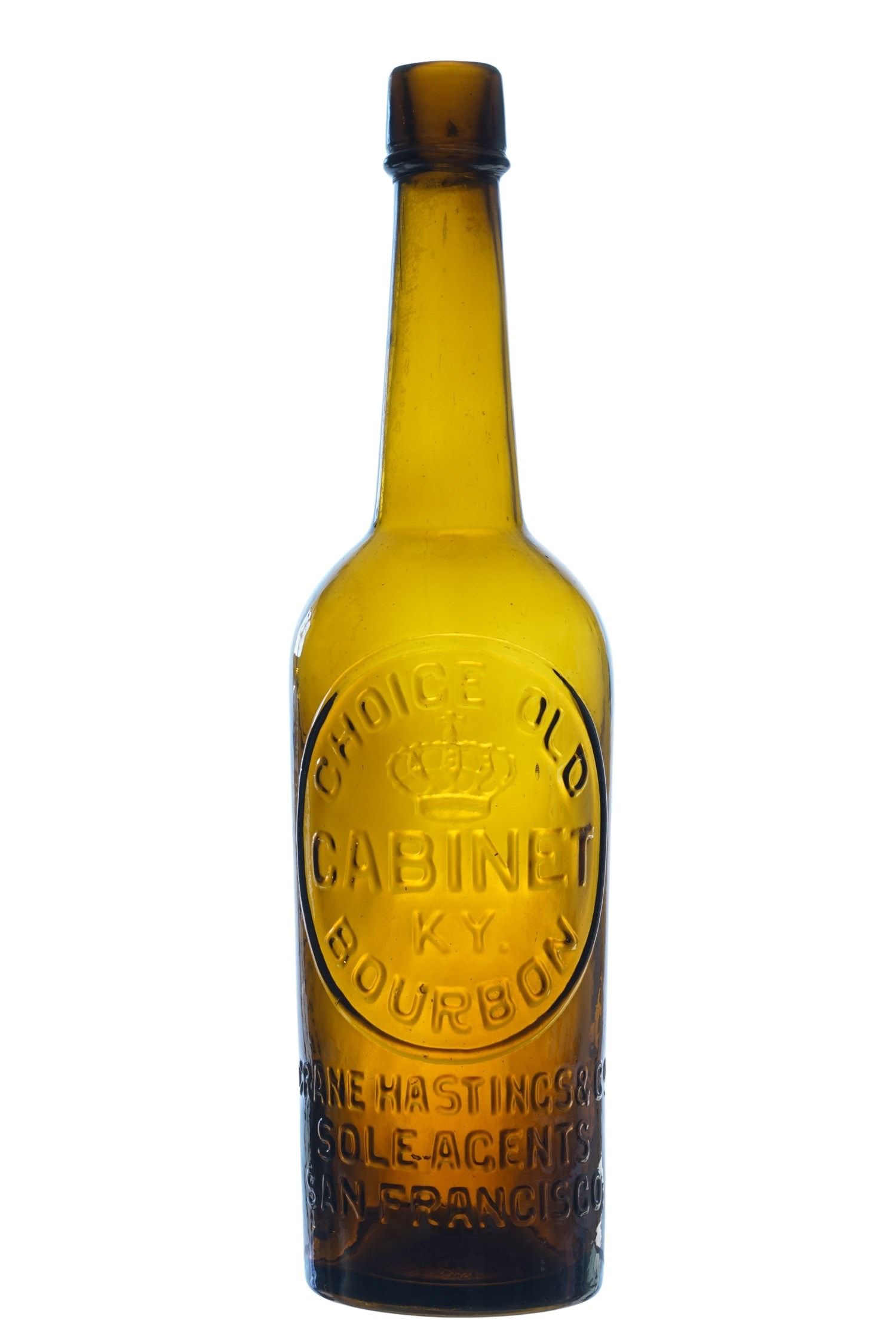
Choice Old Cabinet K.Y. Bourbon
Circa 1878–1890, applied top, fifth. A popular Western fifth featuring bold, extensive embossing. Although the trademark for this design was not filed until 1885, advanced West Coast diggers have reported recovering examples from late 1870s and early 1880s contexts on numerous occasions. It is therefore likely that Crane, Hastings & Co. had been using the design for several years prior to officially registering the trademark. The brand appears to have been particularly popular in Washington State, where a surprising number of examples have been dug. Applied–top examples occur in two molds: an earlier variant characterized by flatter, rounder embossing, richer color variations, and a smaller applied top, and a later reworked mold with sharper embossing, less color variation, and a larger, distinctly mid–to–late–1880s style top. Finding an example that combines a strong strike with any shade of yellow or olive is extremely difficult.
Description & Condition: Strong strike in the early mold. Great color with a pleasing amount of olive. Appears to have been professionally cleaned. Minor interior stain remains in the neck and shoulder. A few insignificant surface impacts, the largest measuring approximately 1/16" on the U in Bourbon, along with two smaller flakes on the base edge.
Min. Bid $1,000 - Est. $2,000–$4,000
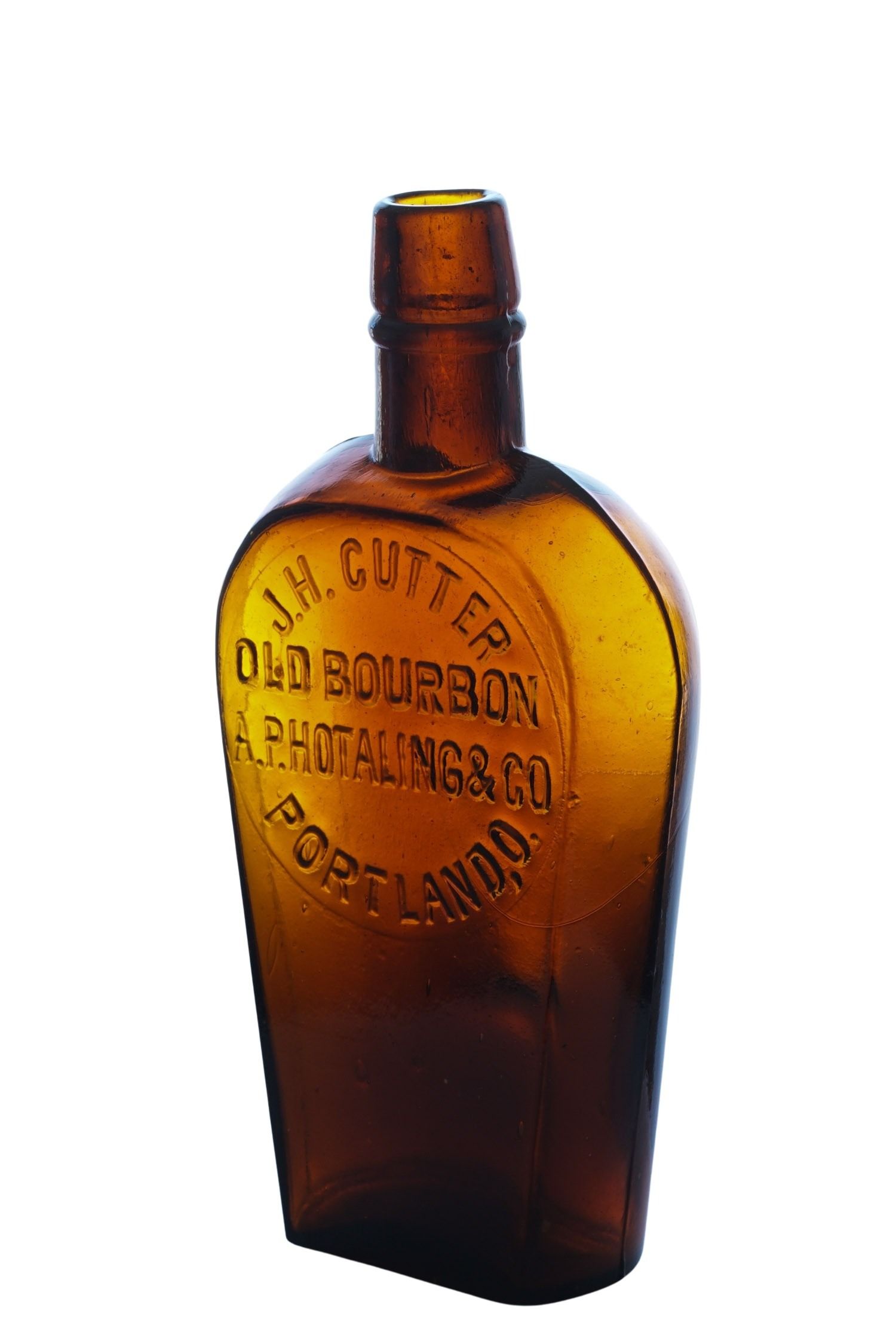
J.H. Cutter Old Bourbon A.P. Hotaling & Co Portland, O.
Circa 1880s–1890s, tooled top, pint. A rare Hotaling flask from Portland, Oregon. These come in both the pint and half pint sizes, with around 15 known examples. By the 1880s, A.P. Hotaling had established a significant presence in the Pacific Northwest and made a variety of embossed bottles from both Oregon and Washington.
Description & Condition: Medium dark amber, clean glass.
Min. Bid $250 - Est. $500–$1,000
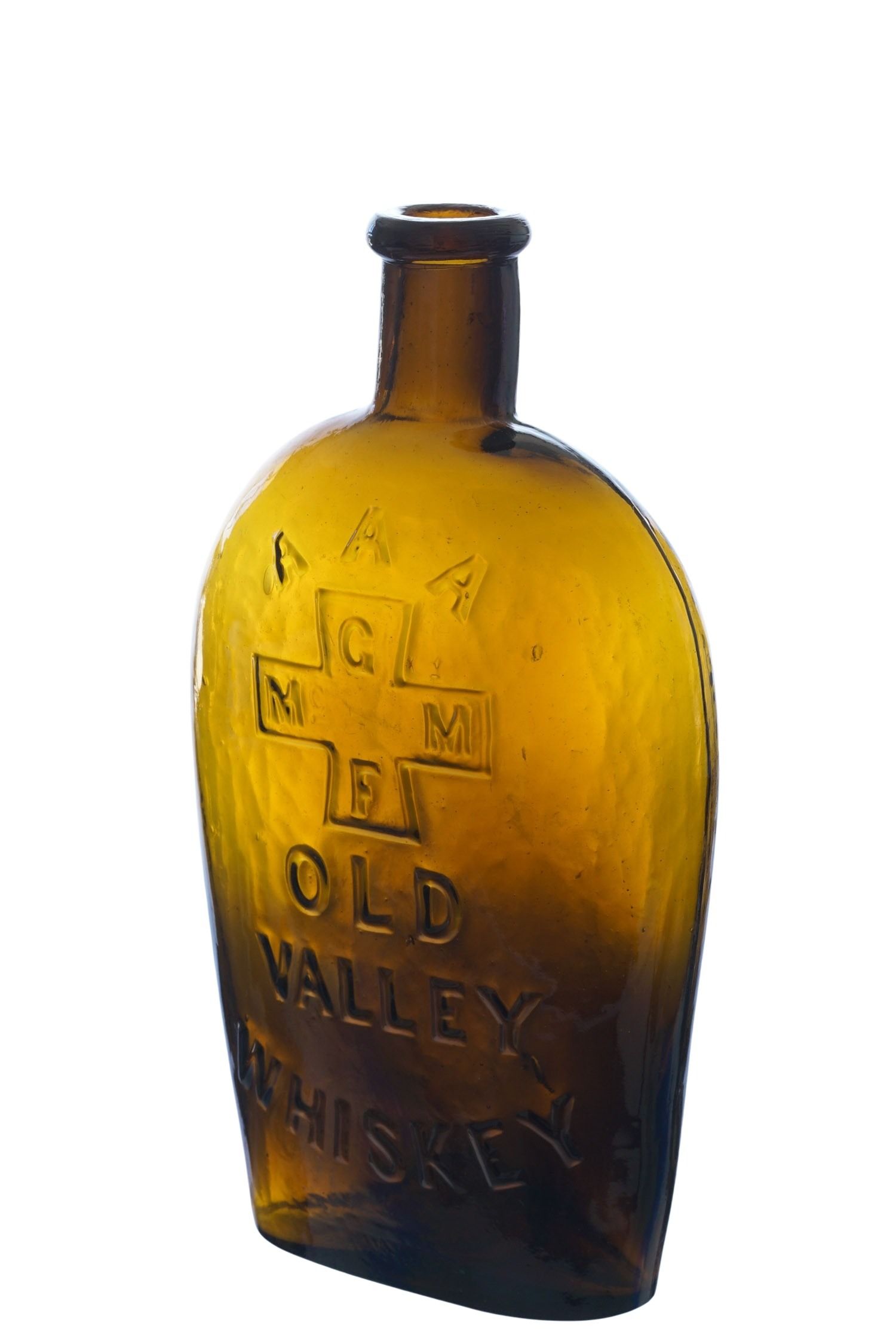
AAA Old Valley Whiskey
Circa 1870s, applied top, pint. A classic Western flask popular throughout the mining regions of the West Coast, especially California's Gold Country and many areas of Nevada. While often referred to as pints, these actually held roughly 20% more than a true pint. They are known in a wide range of colors from yellow to dark amber, with about two examples reported in an incredible light green, almost lime color. Most examples are amber, and many suffer from a weak strike.
Description & Condition: Rich old amber color with a strong strike and light whittle. A solid example.
Min. Bid $400 - Est. $800–$1,500
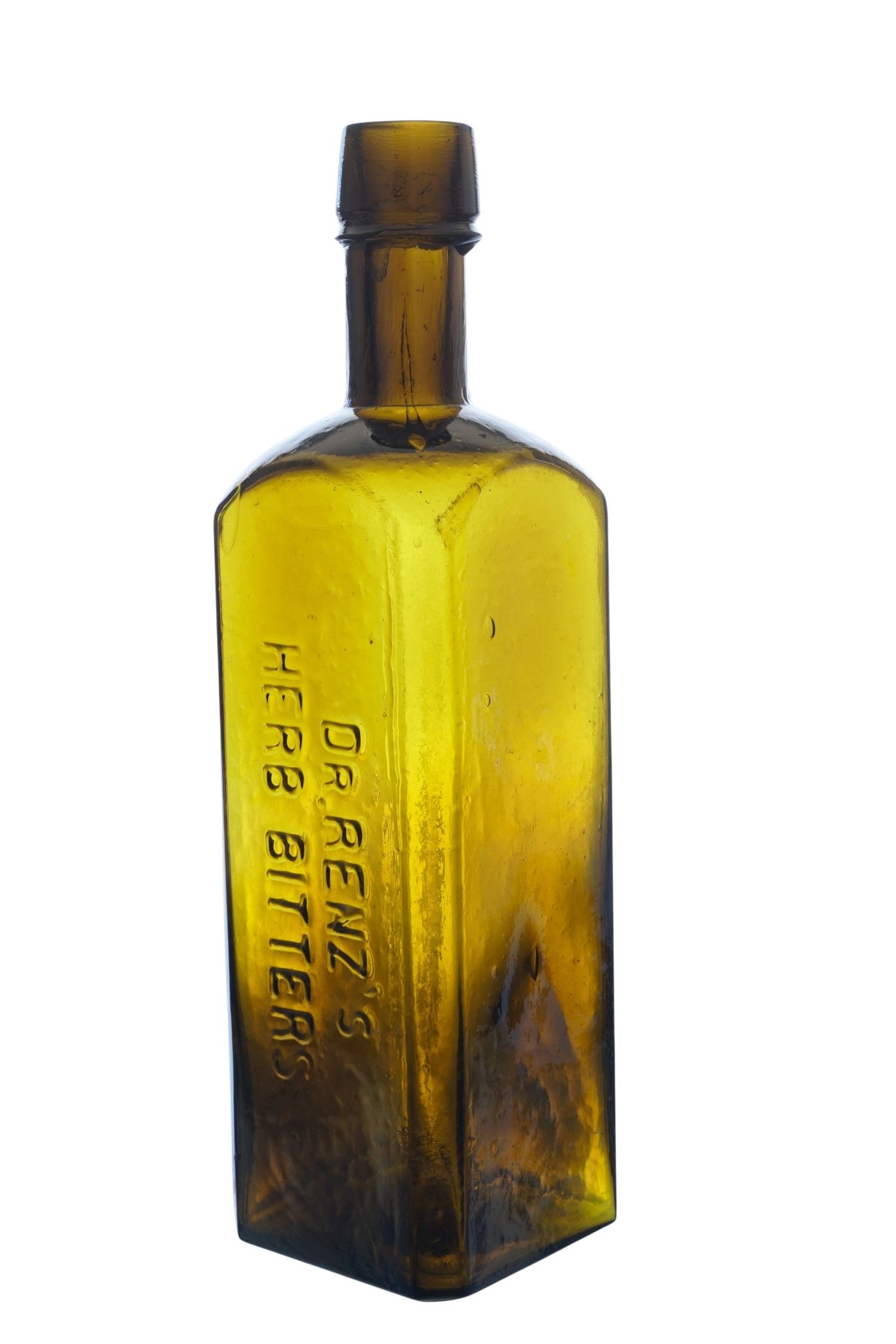
Dr. Renz's Herb Bitters
Circa 1868–1872, applied top. This is the earliest variant of the notorious Dr. Renz's Herb Bitters, affectionately known by collectors as the "Small Letter Renz." These bitters were first marketed in August of 1867 by Dr. C. M. Renz and his son John. Around 1872, John Renz relocated to San Francisco to expand the business, helping establish what would become one of the most famous bitters brand on the West Coast. Produced into the early 1870s, this variant is highly regarded for its vibrant colors and glass crudities. Examples are known in a remarkable range of colors, including aqua, lime green, olive green, yellow green, and even deep emerald green. Surprisingly, amber is one of the rarer colors for this variant. Examples are also found with a variety of lip finishes, ranging from the extremely rare tapered top example known as the "Cone Top Renz" to the more traditional whiskey lip finish found on most examples. This particular example was dug in Virginia City about 10 years ago.
Description & Condition: Olive amber with light whittle and an oversized top. A small amount of interior dirt remains.
Min. Bid $750 - Est. $1,500–$2,500
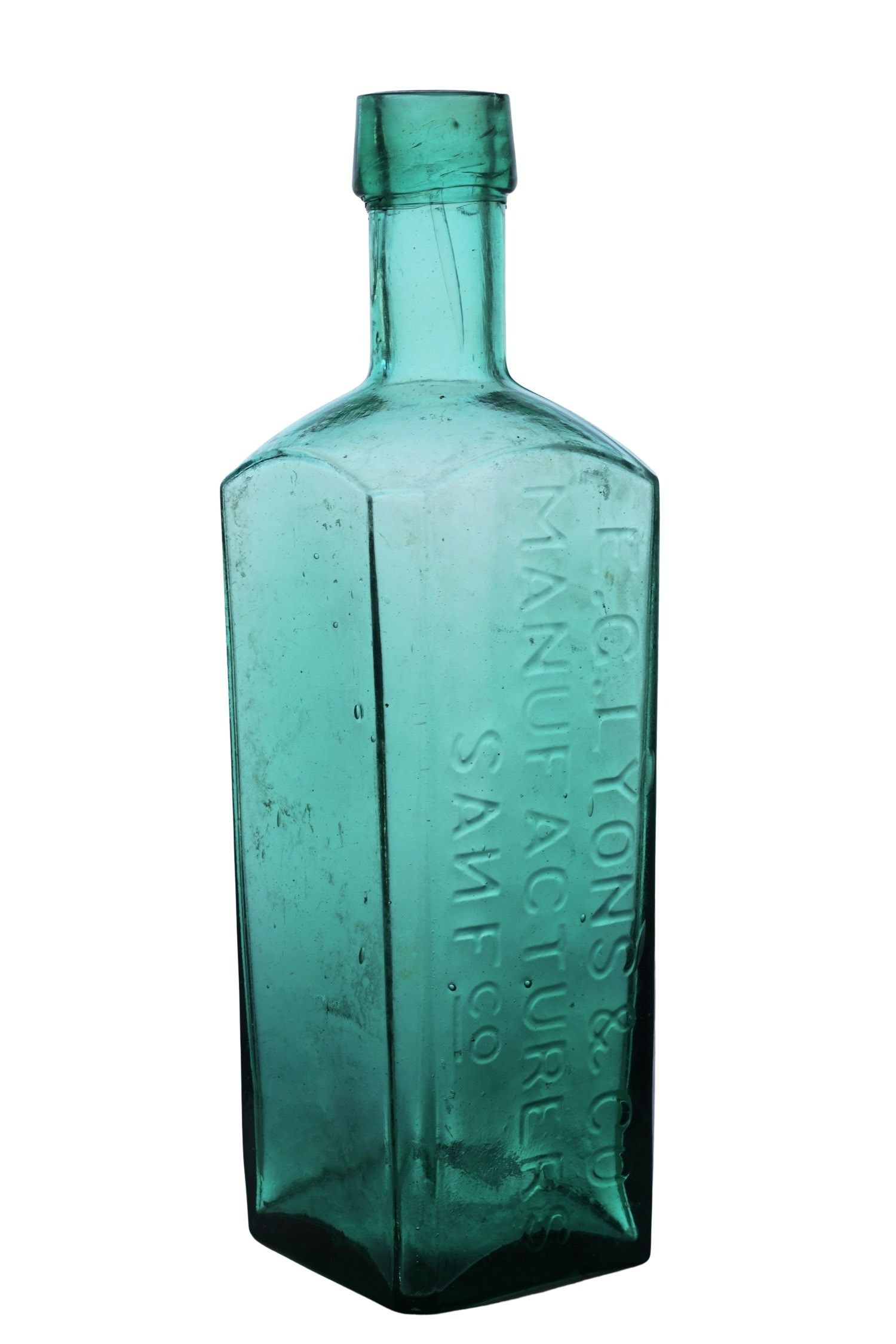
E.G. Lyon's & Co. Manufacturers SANFco
Circa 1863–1870. The E.G. Lyon's square is another early and desirable Western bottle. The earliest examples are believed to have been made during the mid–1860s, although some collectors believe a second run was produced later in the decade or perhaps even into the early 1870s. It is not known exactly what product these bottles contained, and it is likely they served as a generic container for a variety of E.G. Lyon's bitters and cordial products. These bottles feature the unusual abbreviation "SANFCO" for San Francisco, as well as the famous backwards "N" in LYON'S, a characteristic long noted by collectors. Examples are known in a surprising range of colors, from deep olive green through various shades of yellow and amber. This beautiful colored example was excavated by Bob Franconi in 2003 during a bottle digging expedition in Oakland, California.
Description & Condition: Light seafoam green, possibly the only known example in this color. Minor 1/8" chip on the edge of the lip. Some very light, spotty exterior dullness and patina.
Min. Bid $3,000 - Est. $6,000–$12,000
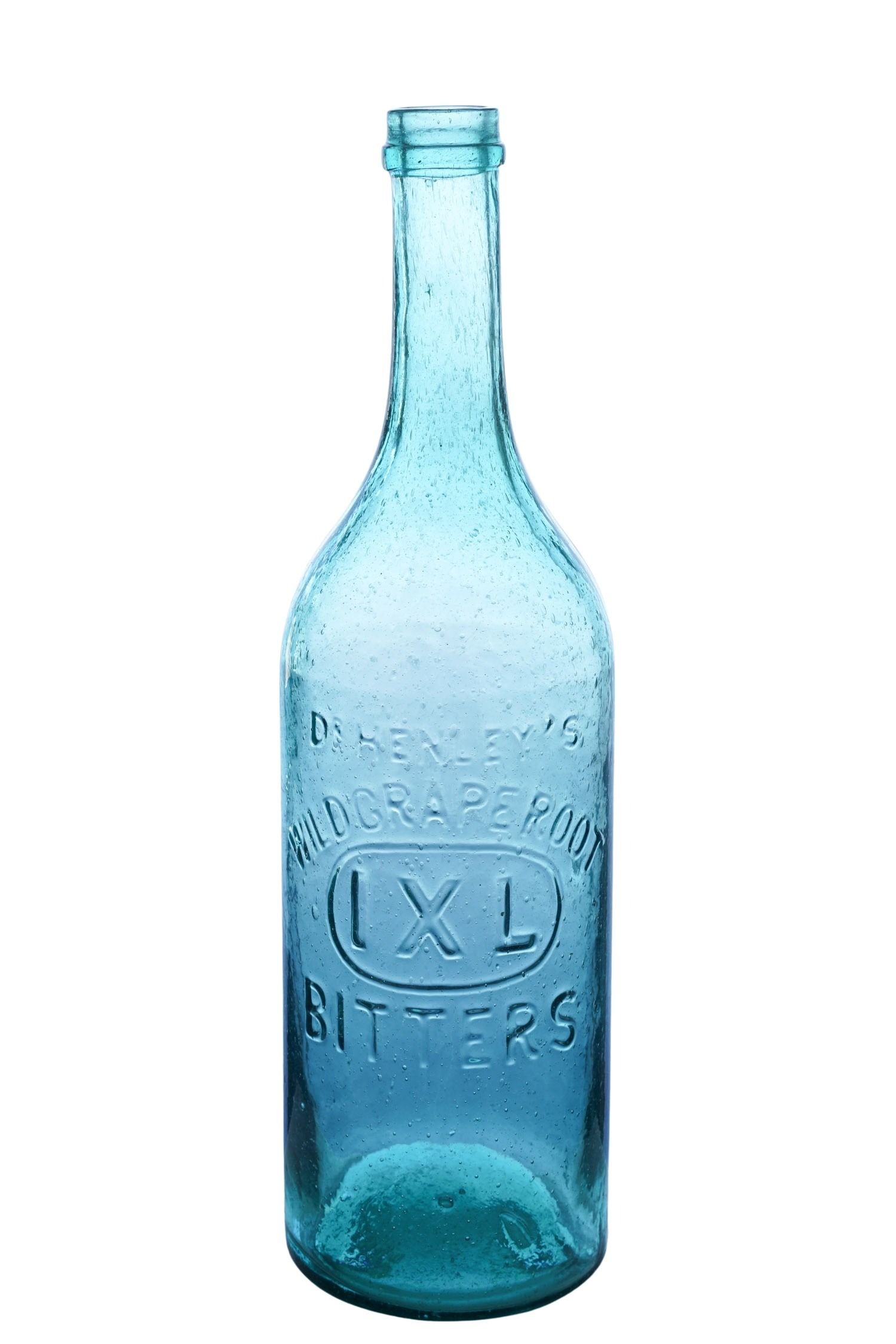
Dr. Henley’s IXL Wild Grape Root Bitters
Circa 1873–1882, applied top, 12 1/8". This is the second variant of the I.X.L. Bitters, featuring a circle surrounding "I.X.L." While this variant is most often encountered in aqua, and occasionally in lighter shades of green, examples in stronger colors are considerably scarcer. Crude, character-rich examples such as this are also much more difficult to find.
Description & Condition: Aqua with a strong strike. Crude glass, full of bubbles.
Min. Bid $75 - Est. $150–$300
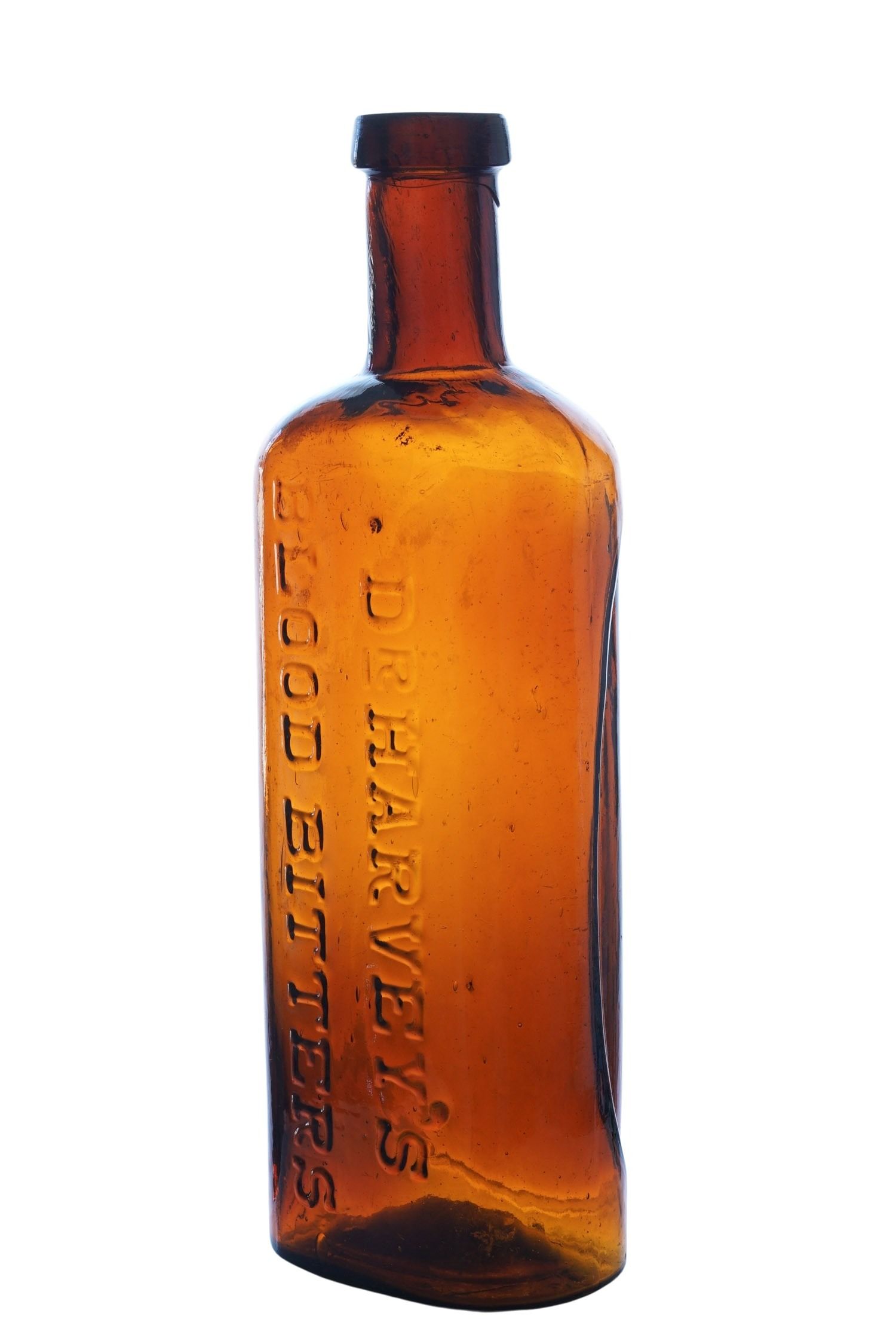
Dr. Harvey’s Blood Bitters
Circa 1881–1885, applied top, 8 3/4". A recently discovered 1881 advertisement identifies Paul Oesting, a Visalia druggist, as an agent for Dr. Harvey's Blood Bitters. Interestingly, the advertisement notes a London depot for Harvey & Son and states the product dated back to 1628, suggesting a connection to the famed English physician William Harvey. Another advertisement from 1884 identifies an agent in Fresno marketing the product as well. Given the bottle's distinctly Western curved R embossing and the documented California distribution network, it seems likely these bottles were produced in San Francisco during the early 1880s. Supporting this theory is the fact that many of the known examples have been recovered in the San Joaquin Valley near Visalia. A rare bitters with a great name.
Description & Condition: Medium amber with some whittle. Light exterior scratching, mostly on the rear recessed panel. Potstone on the reverse with an associated 1/4" bruise.
Min. Bid $500 - Est. $1,000–$2,500
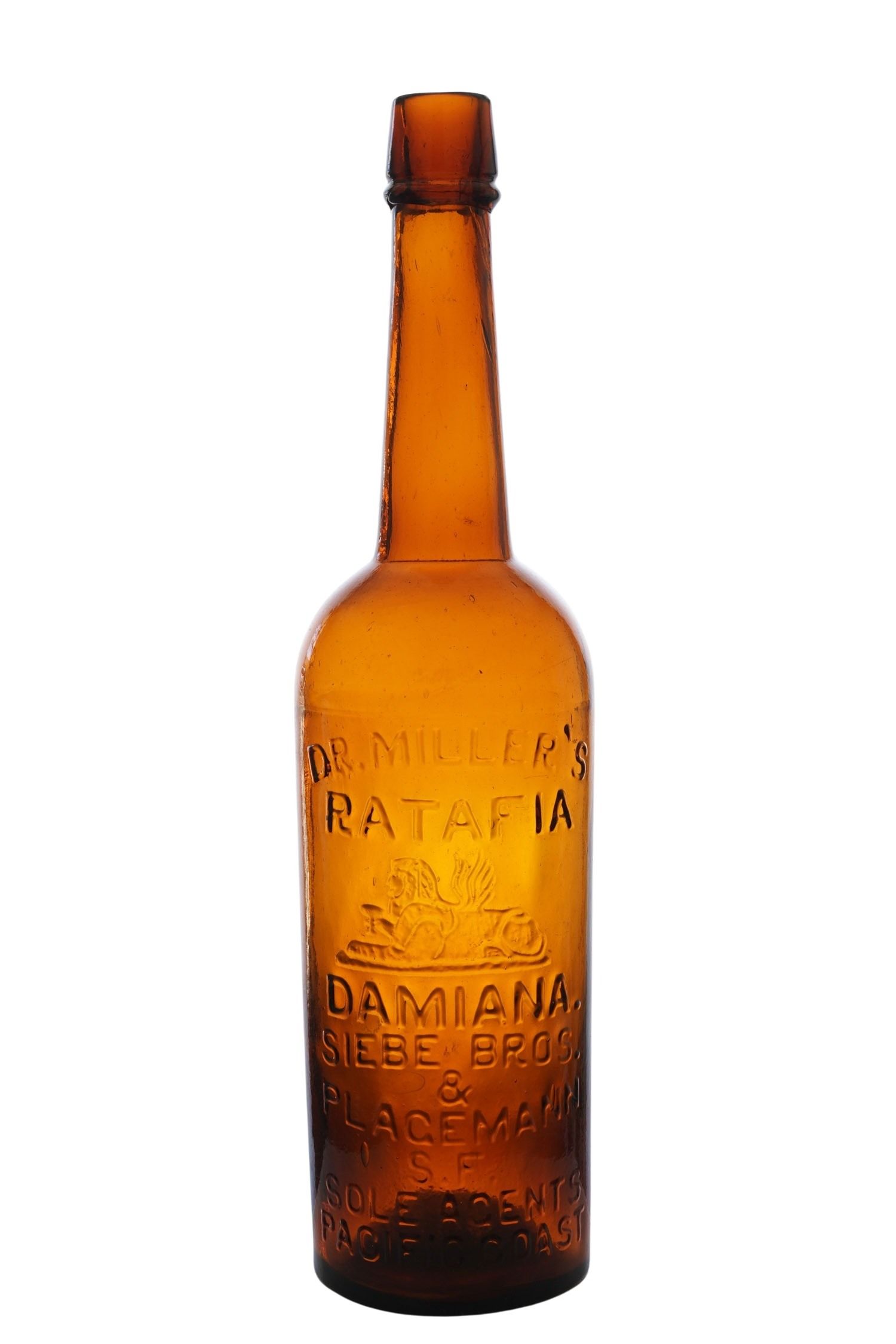
Dr. Miller’s Ratafia Damiana
Circa 1878–1882, applied top, sixth. An incredible Western bottle featuring a large embossed sphinx. These bottles have it all: an embossed animal, extensive embossing, and the coveted "Pacific Coast" embossing prized by collectors. Ratafia was a type of cordial, while damiana was a popular herb native to Mexico and Central America that was often promoted as an aphrodisiac. A few years ago, a broken example was excavated behind a former bordello in California's Central Valley, perhaps a fitting place to find such a product. Approximately a dozen examples are known, with the majority either damaged or suffering from a weak strike. Most examples occur in dark amber or orange amber, although at least one olive–toned example is known. Undoubtedly one of the most decorative and visually striking Western bottles, the Dr. Miller's Ratafia remains a favorite among collectors.
Description & Condition: Medium amber with a strong strike and in much better condition than most examples. The A in Damina has a small white circular mark measuring approximately 1/4". There is no glass loss, and it appears to be a circular bruise, although we are not certain. Please refer to the photographs in the online catalog.
Min. Bid $2,000 - Est. $4,000–$8,000
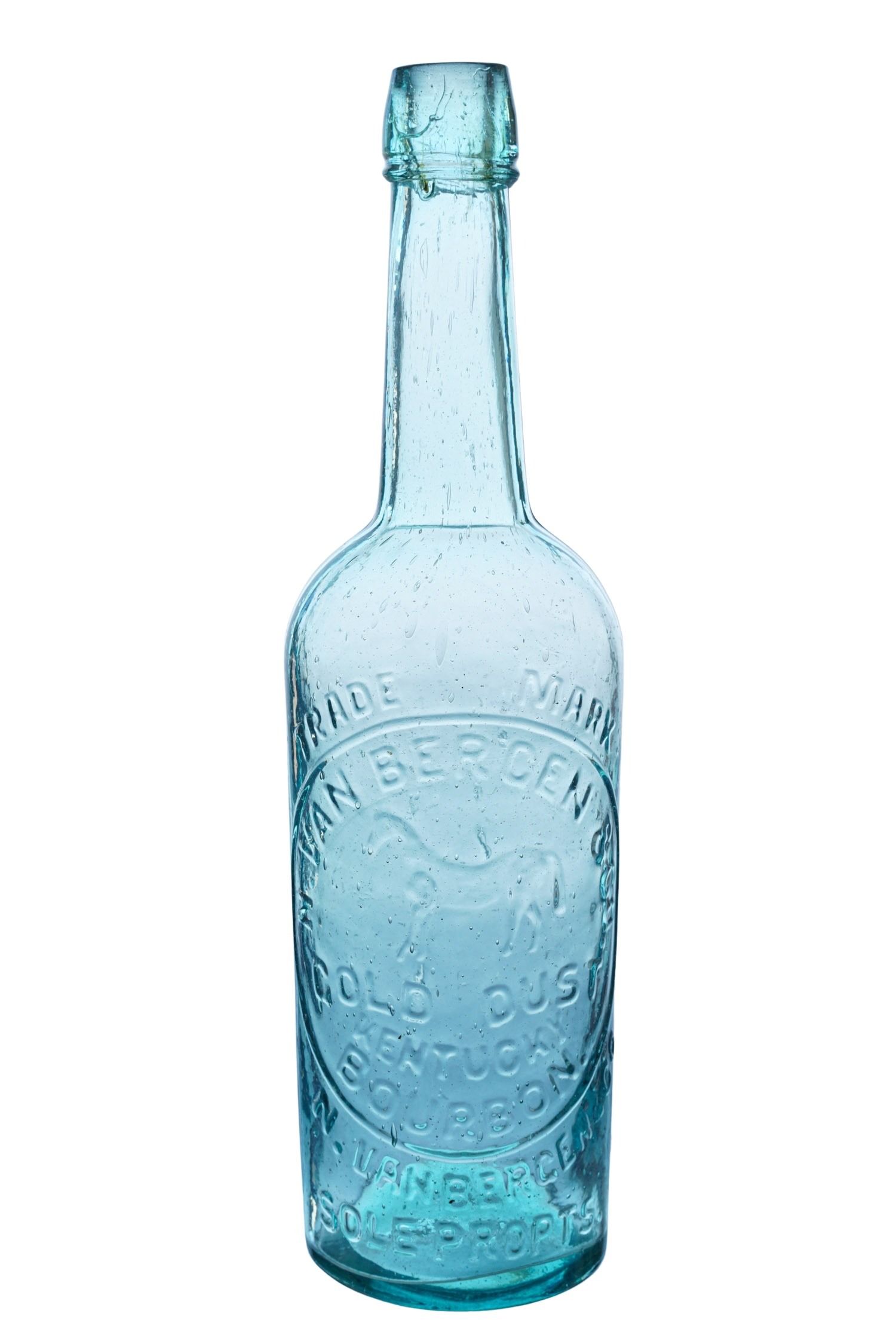
Gold Dust Kentucky Bourbon N. Van Bergen Sole Propts.
Circa 1880–1885, applied top, fifth. A popular Western whiskey fifth that has remained a collector favorite for decades. This is the third Gold Dust variant, likely introduced around 1880 when N. Van Bergen & Co. became the sole proprietor of the brand. These bottles are notorious for weak embossing and condition issues, making this example particularly desirable.
Description & Condition: Strong strike with abundant bubbles and a nice large top. Possibly professionally cleaned.
Min. Bid $600 - Est. $1,200–$2,000
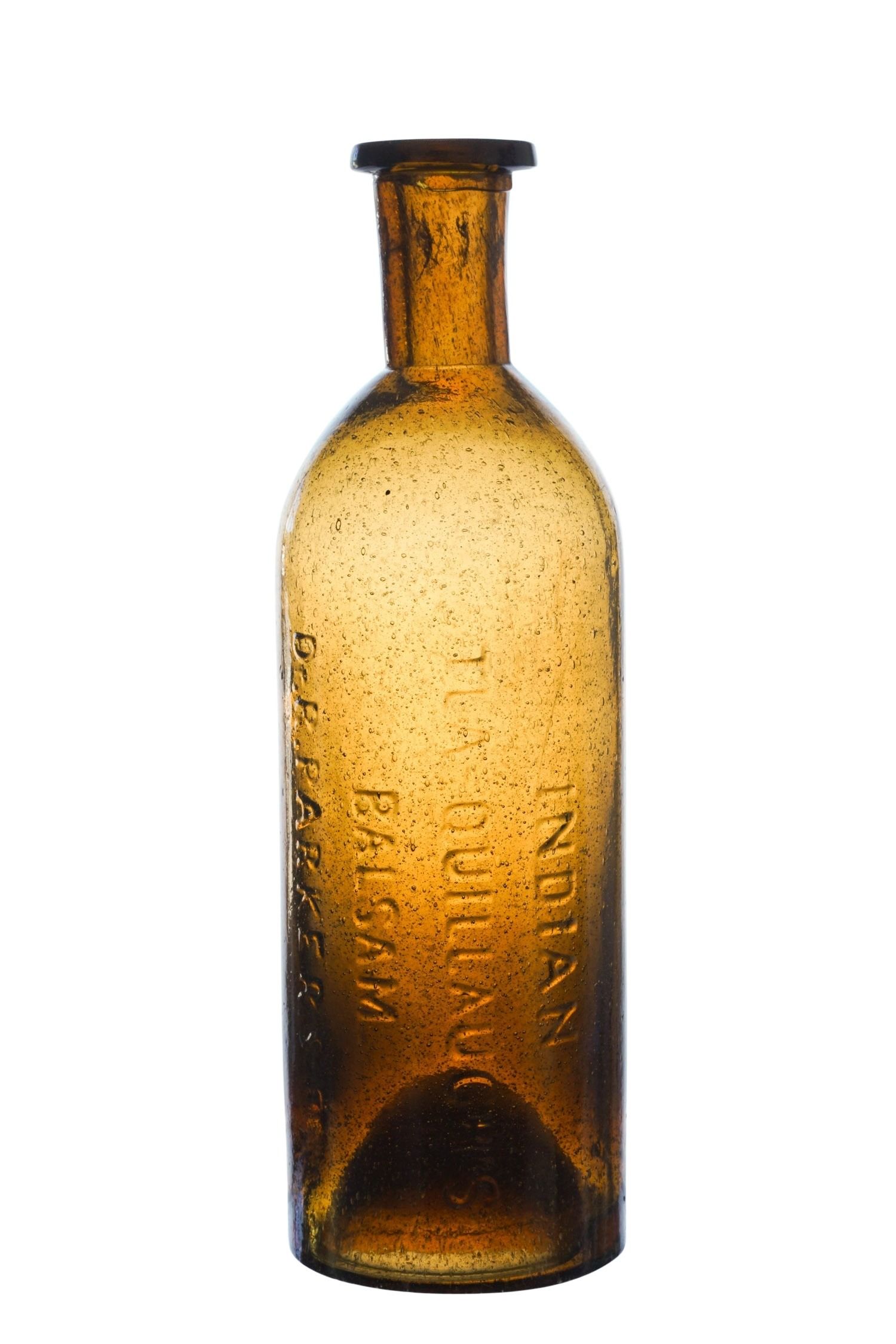
Indian Tla–Quillaugh's Balsam Dr. Parker S.F.
Circa 1864–1865, applied top, 8 1/2". Dr. Ralzemond Parker established his San Francisco business in 1860 and advertised his balsam in 1864 and 1865 before relocating to Oroville by 1866. The product's unusual name likely derives from the Upper Columbia term "Tla-quill-augh," meaning a medicine man or healer. Nineteenth century accounts describe Tla-quill-aughs as individuals possessing supernatural powers and extensive knowledge of medicinal herbs. There are approximately eight known examples, with nearly all exhibiting some form of damage. These bottles are primarily found in two colors: deep olive green and the beautiful peach puce shade seen here. They are believed to have been blown at the Pacific Glass Works and share colors found in the Salutaris Bitters, Wideman & Chappaz, and some of the early Pacific Glass Works whiskey cylinders. Possessing the color, crudity, and rarity sought by advanced collectors, this bottle ranks among the most desirable of all early California medicines and remains near the top of many Western collectors' want lists.
Description & Condition: Beautiful peachy apricot color with crude early glass loaded with champagne bubbles. The top was professionally replaced above the drip by Maxine Hines in the 1980s and is very difficult to detect with the naked eye. Well–hidden 1/2" bruise on the base, a shallow sliver of a chip on the base edge, and a few minor 1/8" surface impacts scattered throughout the body. Several annealing checks in the neck. All condition issues are subtle, and the bottle displays beautifully. No additional examples have surfaced in more than 30 years, and it is highly unlikely that others will ever be found. For the serious collector, opportunities to acquire a Parker’s may not happen for many years to come.
Min. Bid $3,000 - Est. $6,000–$12,000
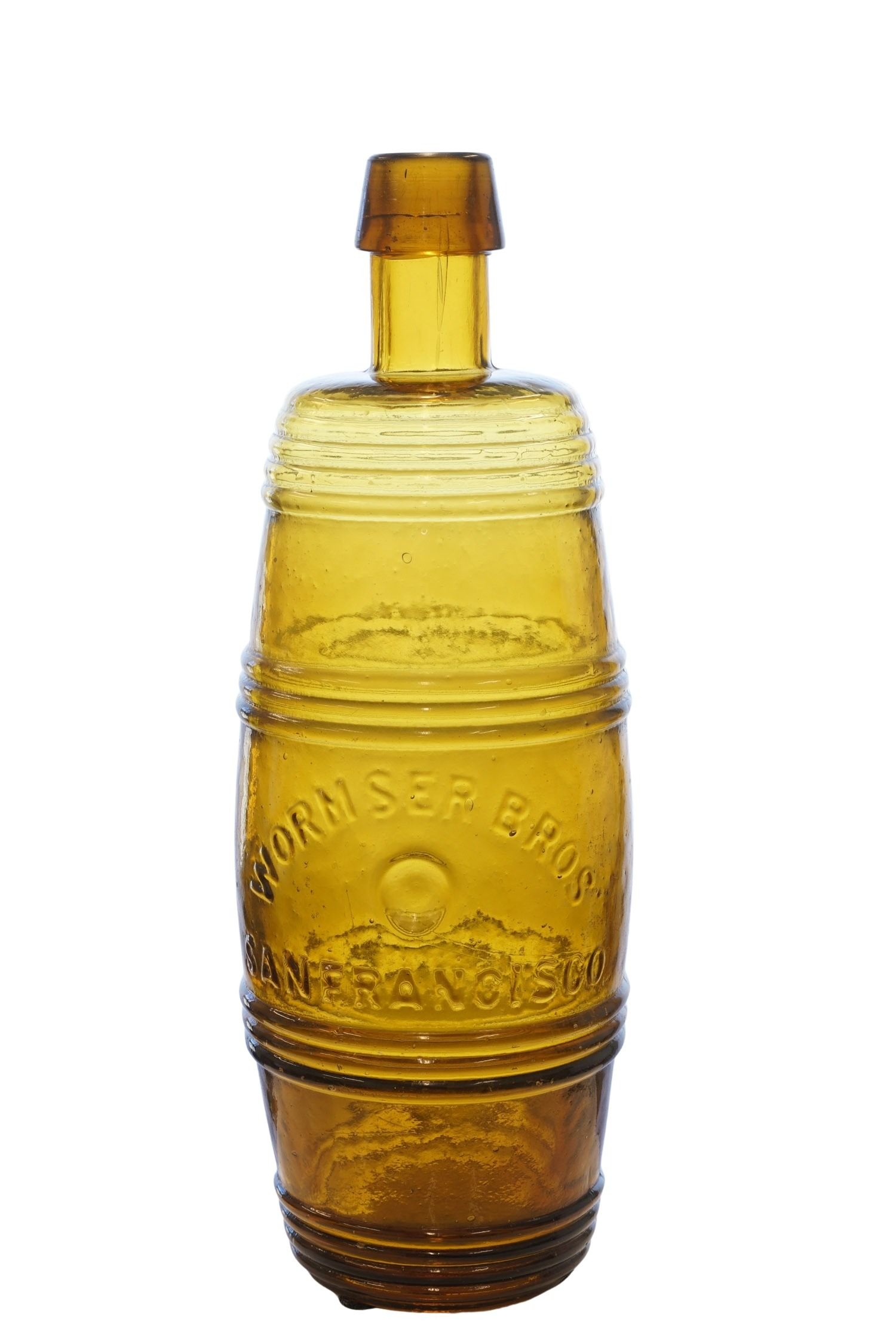
Wormser Bros San Francisco
Circa late 1860s, applied top, 9 5/8". The Wormser Brothers of San Francisco produced the only known barrel shaped bitters from the West, likely drawing inspiration from the numerous barrel bitters produced on the East Coast during the same period. Due to their scarcity today, it appears the product may not have achieved the commercial success of some of its competitors. Examples are typically found in shades of amber, though a few are known in yellow and even green. A staple of advanced Western bitters collections, the Wormser remains one of the more distinctive bitters bottles produced in California.
Description & Condition: Light honey amber color with some whittle. Interior open bubble in the neck, a 1/8" surface check on the ring near the base, and a few very small surface pings measuring 1/32" or smaller. Better color than most examples.
Min. Bid $350 - Est. $700–$1,400
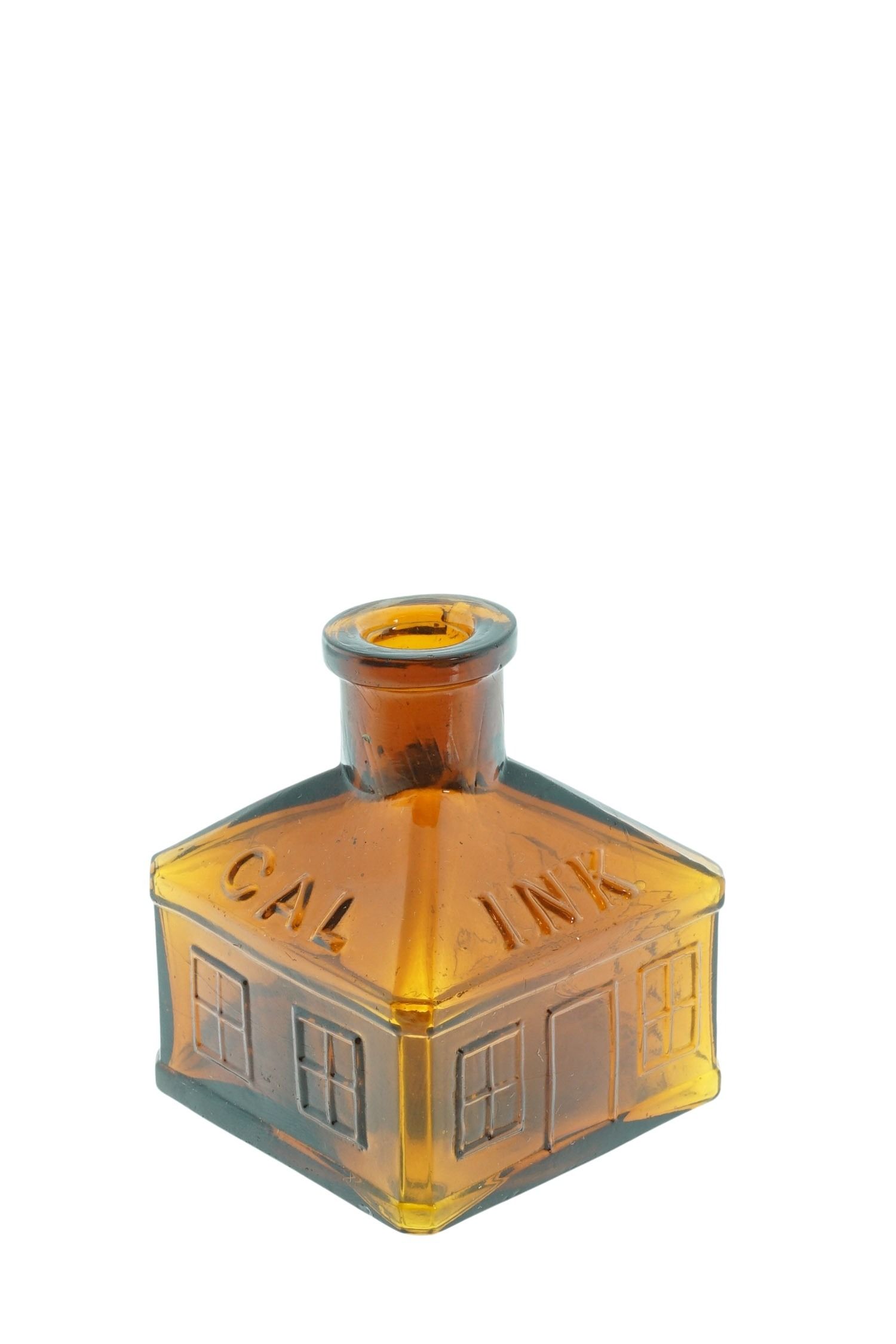
Cal Ink Co. S.F.
Circa 1880s–1890s, tooled top, 2 3/8". A very rare Western ink with only a couple of known examples reported. This example was recovered from an Oakland, California privy about ten years ago alongside a Hostetter's Bitters and a Bliven Soda. It is documented that the California Ink Company was not operating in San Francisco until the 1890s, yet more than one of these bottles have been found in contexts predating the 1890s by at least five to ten years. Interestingly, a California Ink Company was operating in National City, California, as early as 1881. Perhaps that firm maintained an agent or distributor in San Francisco and marketed its products in these embossed bottles. Additional research is needed to better understand the history of this bottle. The design closely resembles the aqua NE PLUS ULTRA FLUID schoolhouse ink bottle, a form that likely predates these examples by several years.
Description & Condition: Amber. Tiny 1/16" bruise/flake to the bottom of the lip and a 1/16" flake near the base edge. Professionally cleaned.
Min. Bid $500 - Est. $1,000–$2,000
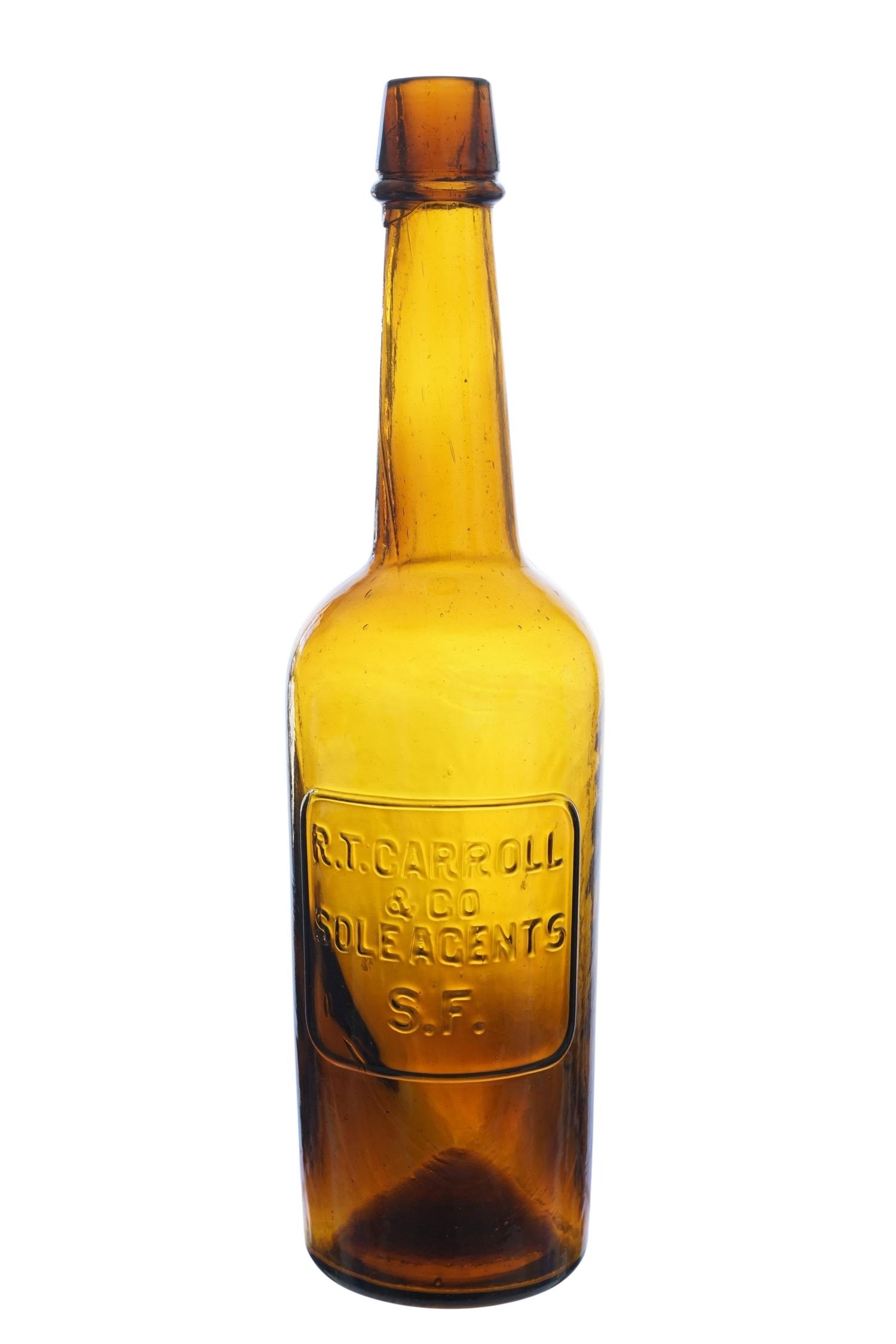
R.T. Carroll & Co. Sole Agents S.F.
Circa 1875–1882, applied top, fifth. A very rare 5th with only a handful of known examples. An 1880 advertisement for R.T. Carroll shows the company was marketing several brands of Kentucky whiskey, including Kentucky Cabinet, Imperial, and Park Rye. Another advertisement from 1881 notes that the firm was the sole Pacific Coast agent for Robertson County Tennessee Whiskey. Perhaps that exclusive agency prompted the production of this slug plate 5th.
Description & Condition: Light amber color transitioning to honey amber in the shoulders. A large swirl passes through the slug plate. Regarded as the finest known example of this rare bottle.
Min. Bid $1,500 - Est. $3,000–$6,000
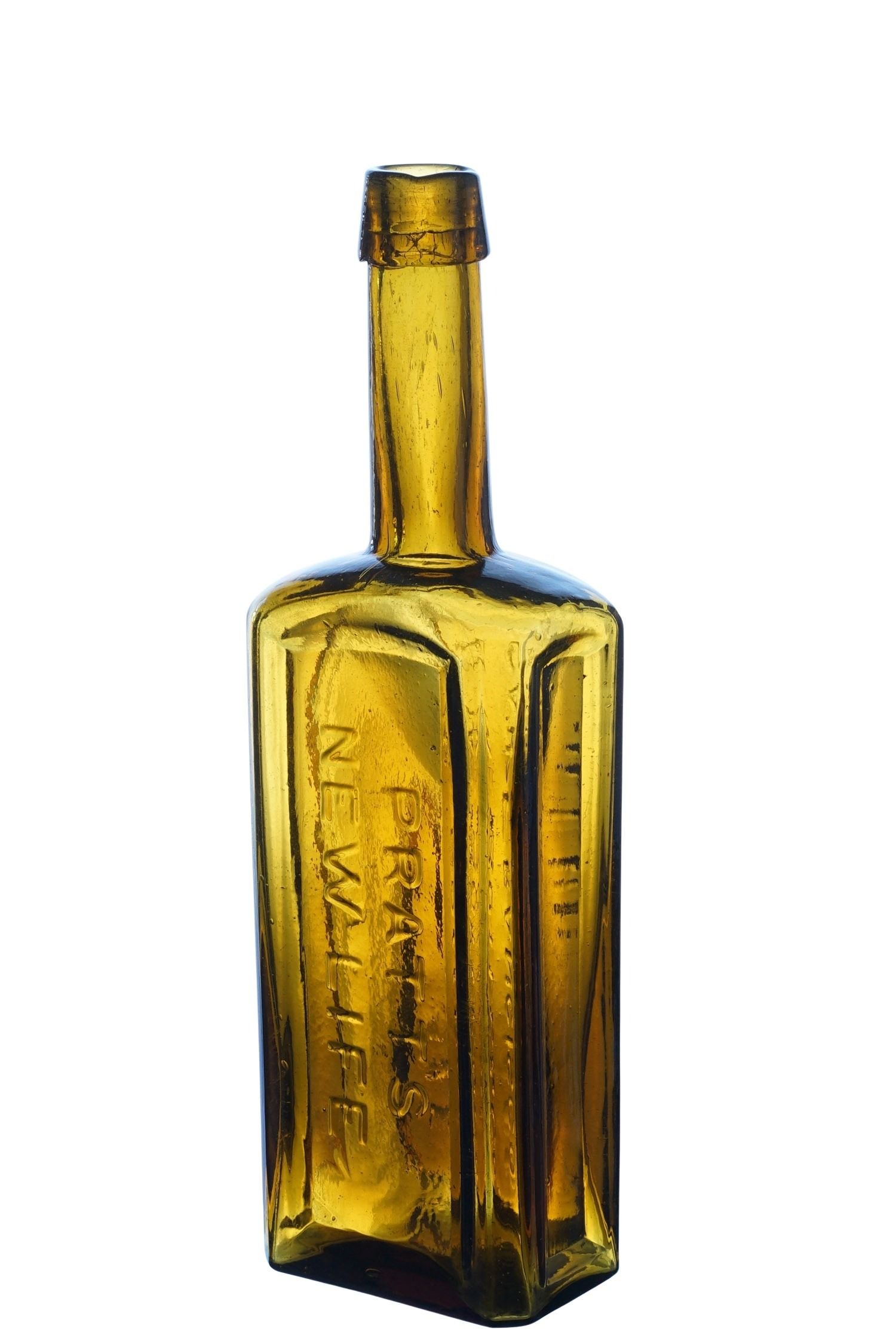
Pratt's New Life A.M. McBoyle & Co San Francisco
Circa 1868–1875, applied top, 7 1/2". A rare Western medicine that was virtually unknown before the famous San Francisco "Big Dig" of 1999. We can account for only two examples found outside of the "Big Dig", one in Carson City and one in Oakland, California. This medicine was promoted as a botanical blood purifier and liver invigorator, claiming to strengthen the stomach, regulate the bowels, and cure a wide range of ailments. Contemporary advertisements stated it was prepared from fresh Shaker roots and herbs, reflecting the era's growing popularity of botanical patent medicines.
Description & Condition: Honey amber color, slightly lighter than many known examples. Crude, slightly crooked neck. Two small 1/8" chips to the underside of the top, a few areas of light scratching along the panel edges, and two 1/8" areas of light abrasion on the panel edges. Still in better condition than most examples, many of which have significant damage or repairs.
Min. Bid $200 - Est. $400–$800
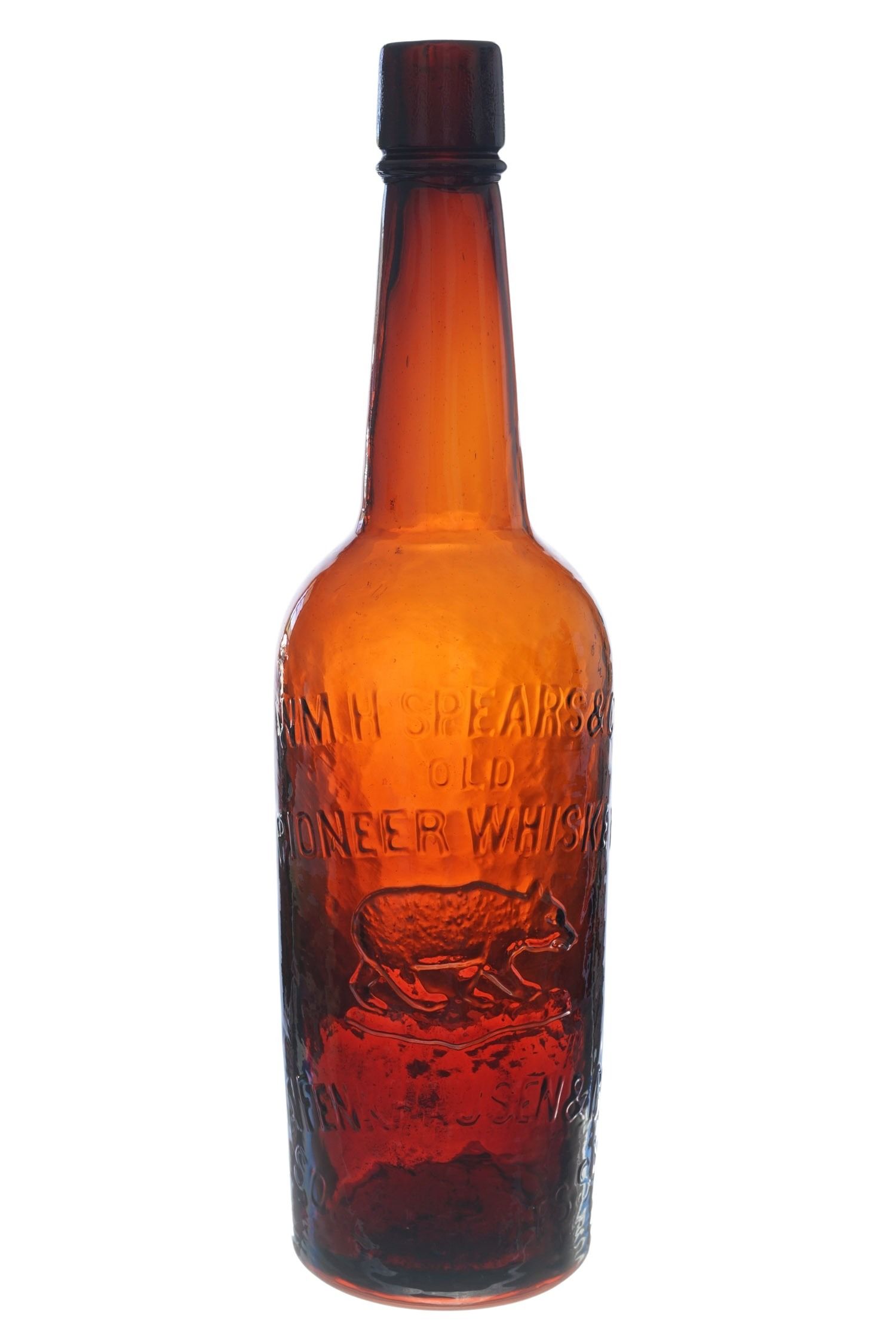
WM. H. Spears & Co. Old Pioneer Whiskey
Circa 1890s, applied top, fifth. One of the rarest of all the Fenkhausen fifths, this is the highly desirable German red whittled variant. These bottles are prized for their heavy whittle and beautiful shades of red. This particular variant appears to have enjoyed greater popularity in the logging regions of the Pacific Northwest, where a number of broken and whole have been found. With its boldly embossed walking bear and prominent Old Pioneer name, this bottle is likely to remain high on the list of any serious Western whiskey collector.
Description & Condition: Red amber color with abundant whittle and a strong strike. A beautiful German "red whittle" fifth.
Min. Bid $750 - Est. $1,500–$3,000
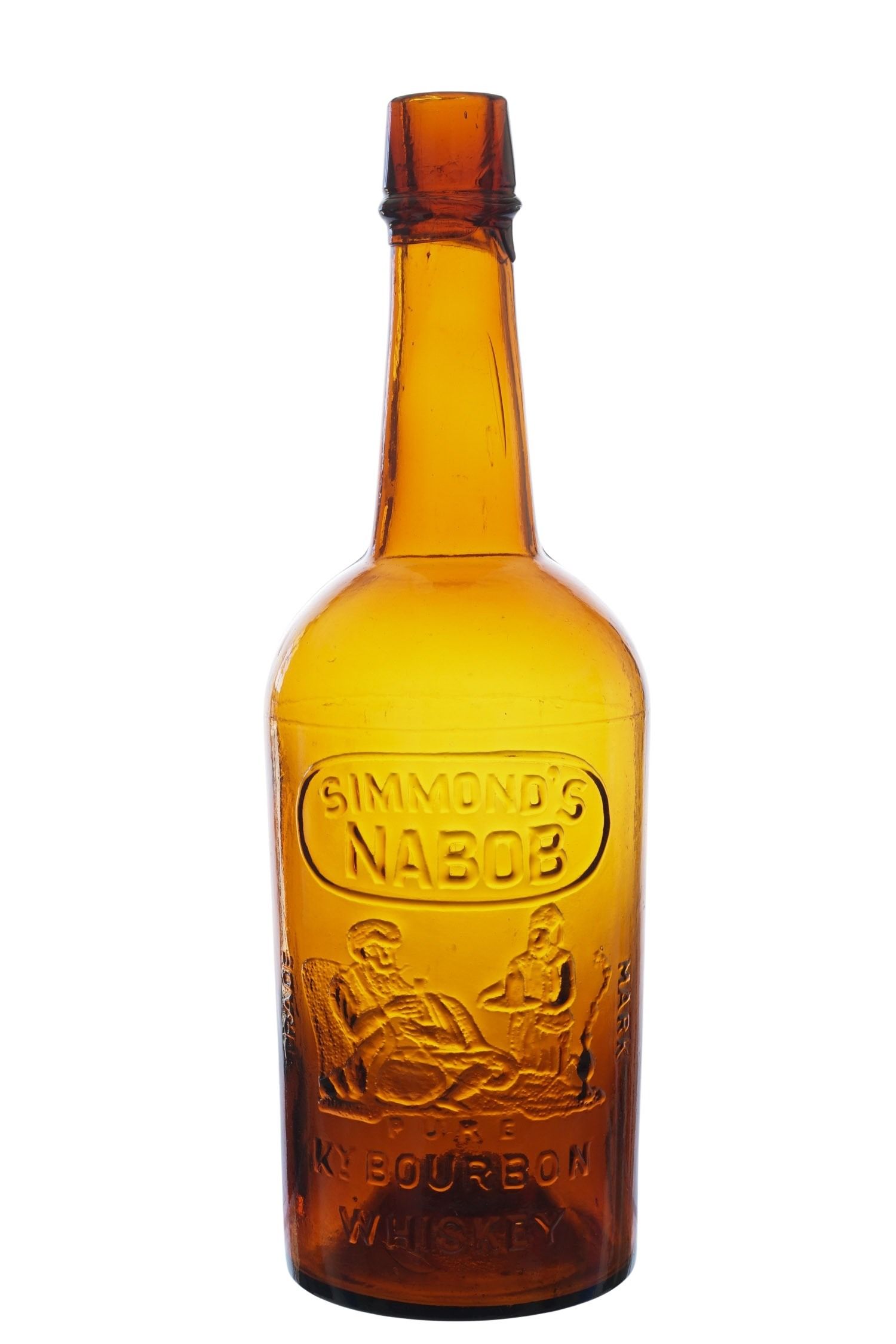
Simmond's Nabob KY Bourbon Whiskey
Circa 1879–1887, applied top, fifth. The rarest of all the picture Nabob fifths. While the entire bottle was produced from a different mold, the easiest way to identify this variant is the "Simmond's Nabob" embossing enclosed within a circle. In addition, the embossing exhibits the distinctive Western curved Rs found on many Western blown bottles of the era. The striking image of a Nabob smoking a hookah is among the most memorable Western whiskey designs of the nineteenth century. The term "Nabob" was commonly used to describe a wealthy or influential person and was likely chosen to convey an image of prosperity and refinement. An exceptionally rare Western fifth that may not surface again for many years.
Description & Condition: Light amber color. Large drip off the applied top. Paper-thin bubble, about 1/8", on the interior edge of the lip, likely opened during manufacture. Small patch of wear on the reverse, approximately 5/8" long.
Min. Bid $1,000 - Est. $2,000–$4,000
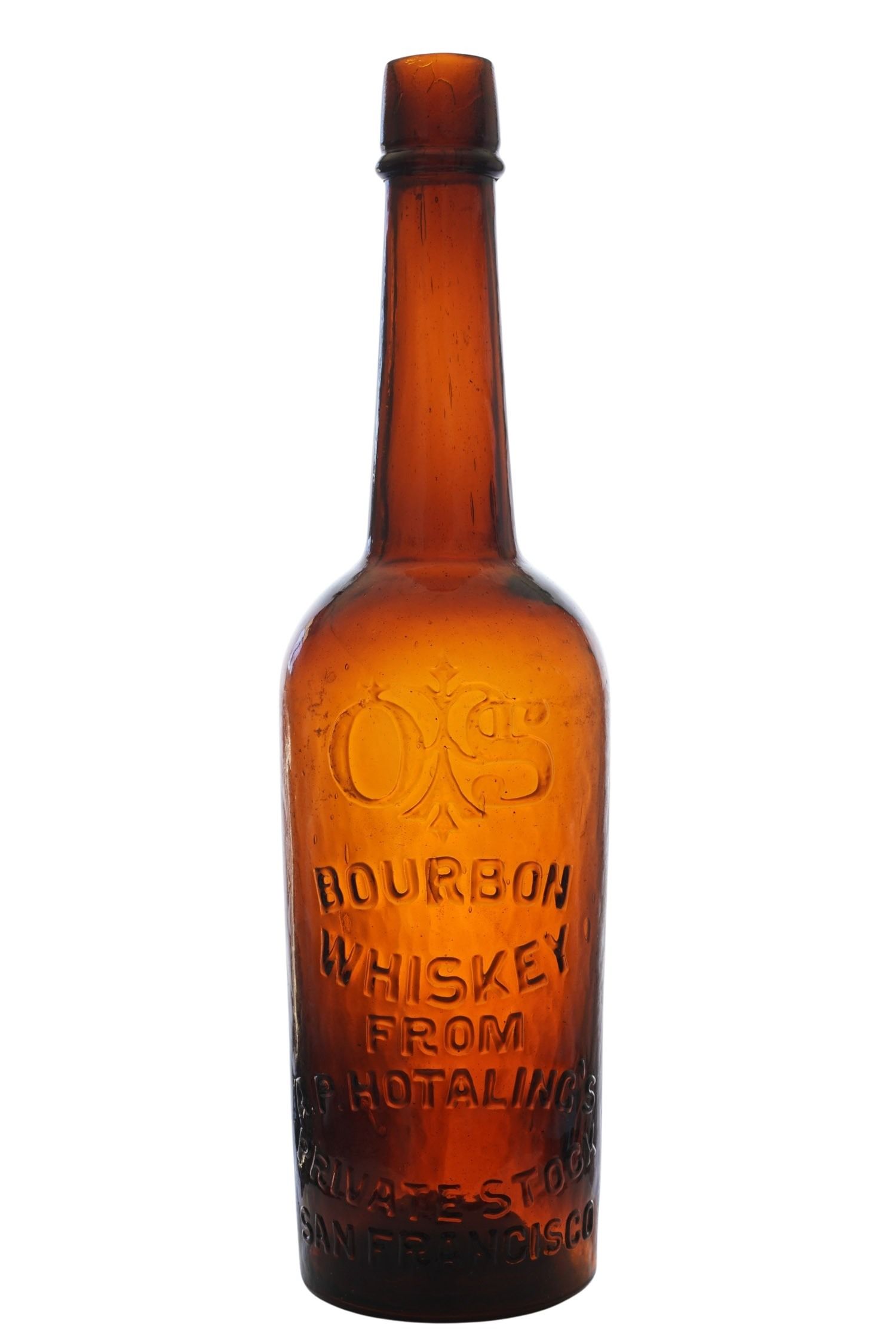
O.P.S Bourbon Whiskey A.P. Hotaling & Co.
Circa 1879–1885, applied top, fifth. A boldly embossed Western fifth featuring a large and ornate monogram that makes it one of the more distinctive Hotaling whiskey bottles. Like many Western fifths of the era, examples have been found across several Western states, with concentrations in early mining camps and logging communities. The combination of extensive embossing, Western history, and broad frontier distribution has long made this one of the more popular Hotaling 5ths among collectors. This is the rare variant lacking the "Old" before "Private Stock." There are believed to be less than 5 known examples of this variant. Thomas # 53.
Description & Condition: Amber color with a strong strike and abundant whittle. Very faint exterior patina and a minor area of wear on the front left shoulder.
Min. Bid $1,000 - Est. $2,000–$4,000
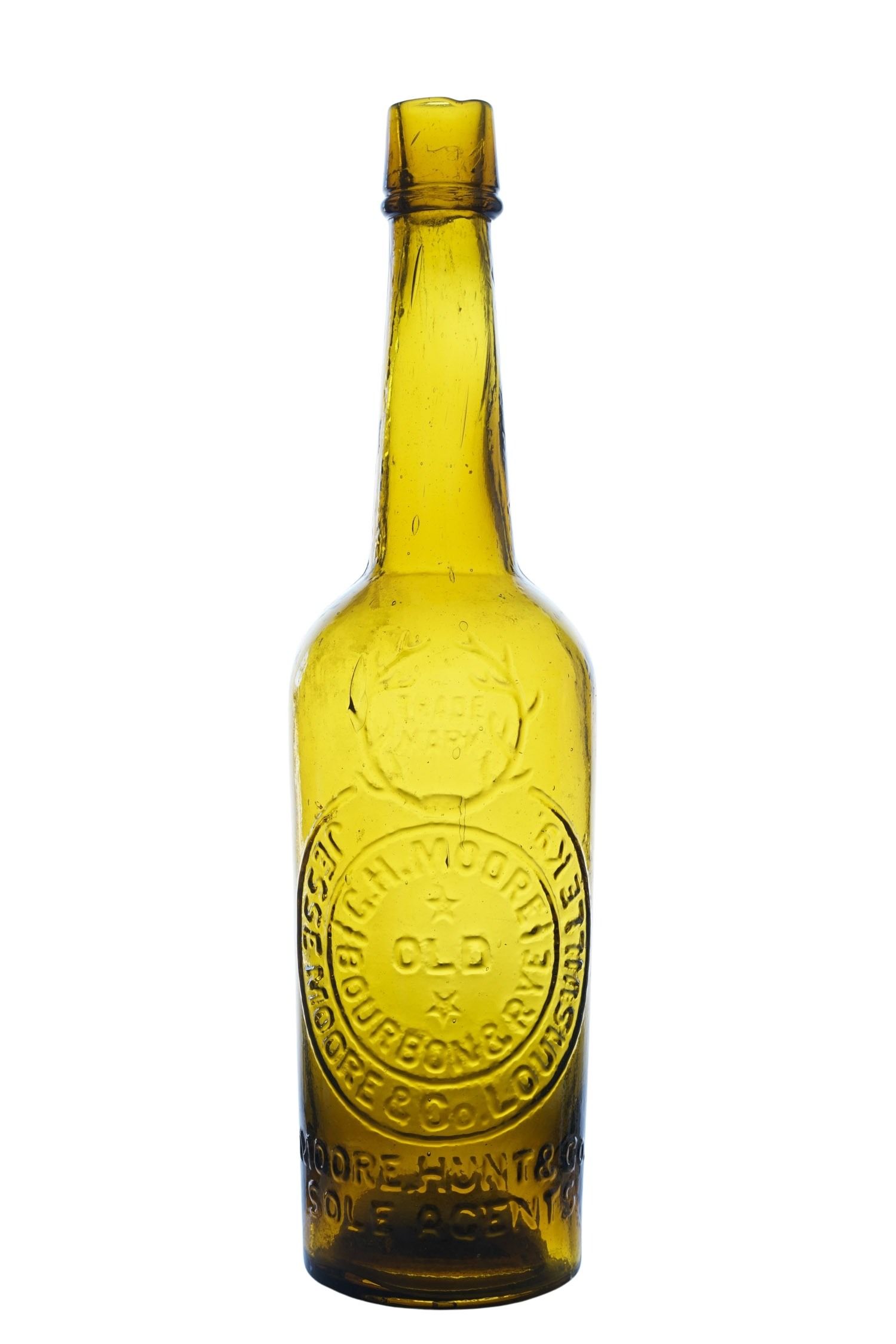
Jesse Moore Old Bourbon
Circa 1880–1885, applied top, fifth. This is the second mold of the Jesse Moore fifths, distinguished by the vent mark on the shoulder. Jesse Moore began as a Louisville liquor dealer before expanding into whiskey production, eventually building one of the best known bourbon brands in the American West. Its iconic stag antlers make it one of the most recognizable Western whiskey bottles. An 1890s trademark filing states the design had been in use since 1860. Distributed through San Francisco by Moore, Hunt & Co., Jesse Moore whiskey became one of California’s most recognizable bourbon brands by the early 1880s. As a testament to the brand’s popularity, Jesse Moore bottles have been excavated in nearly every Western state. While Jesse Moore fifths are obtainable, examples in anything other than medium or dark amber can be extremely difficult to find.
Description & Condition: Vented variant. Bright yellow color with a touch of citron. Never cleaned, retaining a tiny amount of interior residue. An exceptional example that was in the Ken Schwartz collection for many years.
Min. Bid $250 - Est. $500–$1,000
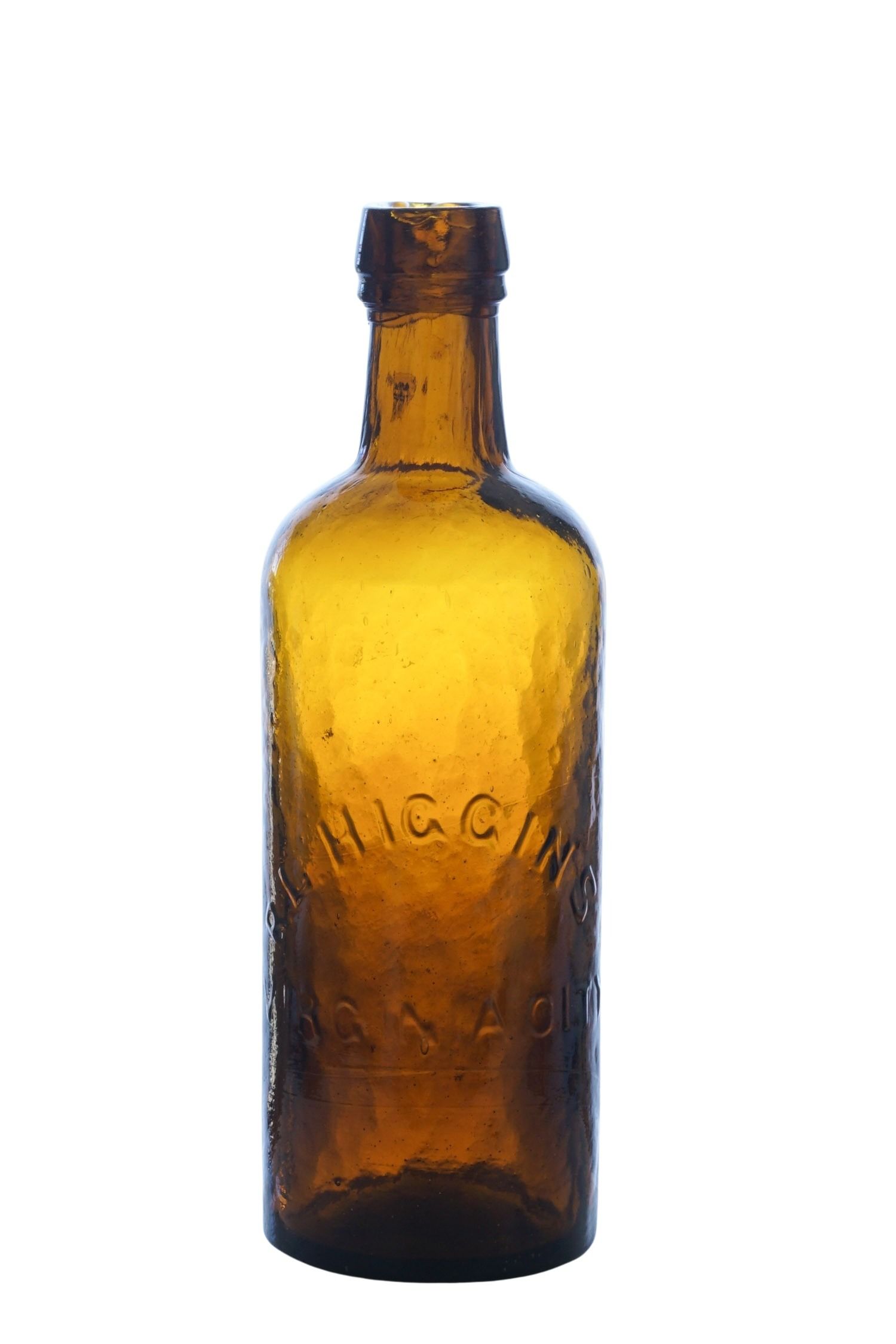
R.L. Higgins Virginia City
Circa 1871–1875, applied top, 6 1/2". Rufus L. Higgins was a Virginia City pioneer who arrived around 1863 and participated in a variety of business ventures. An 1871 advertisement notes he operated the "Virginia Dollar Store," where everything from women's undergarments to picture frames could be purchased for one dollar or less. By 1873 he had moved into a new location and shifted his focus to stationery and writing supplies. Unfortunately, his business was destroyed in the Great Fire of 1875, and he was forced into bankruptcy shortly thereafter. This bottle is one of the few embossed Western ink bottles and the only known Western master ink besides the base–embossed Pacific Glass Works master ink. These are exceptionally rare, with only two amber examples and approximately three aqua examples known. Both amber masters were discovered in California: one by Mike Dolcini in Davis and the other by Randy Haumann and Ralph Van Brocklin in San Francisco. The example offered here is the latter bottle, excavated by Randy and Ralph in San Francisco.
Description & Condition: Dark golden amber color with abundant whittle and crude glass. A beautiful early Nevada bottle.
Min. Bid $4,500 - Est. $9,000–$14,000