Best Of The West Live Auction
November 13, 2026 5:30 PM PT
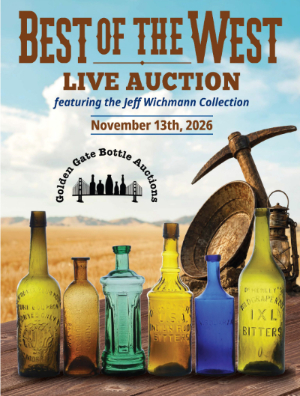
Golden Gate Bottle Auctions is proud to present the Best of the West Live Auction, featuring 72 exceptional lots from the Jeff Wichmann Collection. This special auction showcases an outstanding selection of rare Western bottles, along with four exceptional insulators. Jeff's longstanding passion for Western bottles and his contributions to the collecting community are reflected in this remarkable collection.
The auction will take place Friday, November 13, 2026, at the Gold Country Fairgrounds in Auburn, California, in conjunction with the 49er Bottle Show. Live bidding begins at 5:30 PM Pacific.
Absentee bids will be updated periodically in the online catalog. Please note that online bidding will not be available before or during the live auction on November 13.
→ Register For The Live Auction
The auction will take place Friday, November 13, 2026, at the Gold Country Fairgrounds in Auburn, California, in conjunction with the 49er Bottle Show. Live bidding begins at 5:30 PM Pacific.
Absentee bids will be updated periodically in the online catalog. Please note that online bidding will not be available before or during the live auction on November 13.
→ Register For The Live Auction
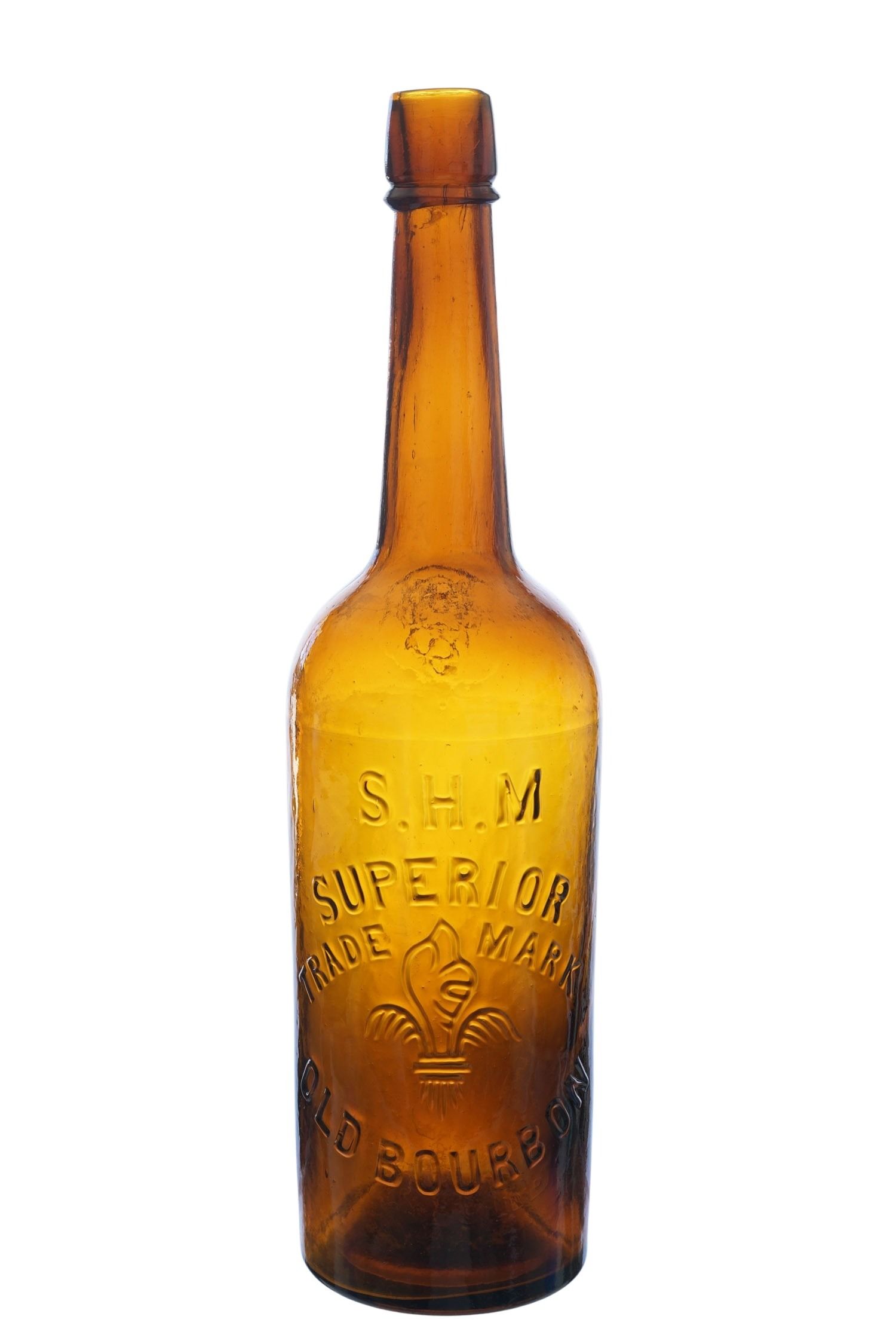
S.H.M Superior Old Bourbon
Circa 1874–1878, applied top, fifth. This is the C&I base embossed variant of the S.H.M. fifth. Some collectors believe the mold was produced by the Cunningham & Ihmsen Glass Works of Pittsburgh, Pennsylvania, and that the bottles were blown there before being shipped West. Another theory holds that the mold itself was sent to California and the bottles were produced in San Francisco. Regardless of its exact origin, it is one of the more attractive pictorial Western whiskeys, featuring a large fleur-de-lis prominently embossed on the face. While approximately twenty examples are known of the more common S.H.M. variant with the larger embossing, this C&I variant remains extremely rare, with roughly three examples known.
Description & Condition: Golden amber color with an abundance of whittle. A minor amount of staining is present in the shoulder and near the base, though it is not noticeable under most lighting conditions. Two tiny pinhead flakes on the top. Overall, an appealing example of this rare bottle.
Min. Bid $750 - Est. $1,500–$3,000
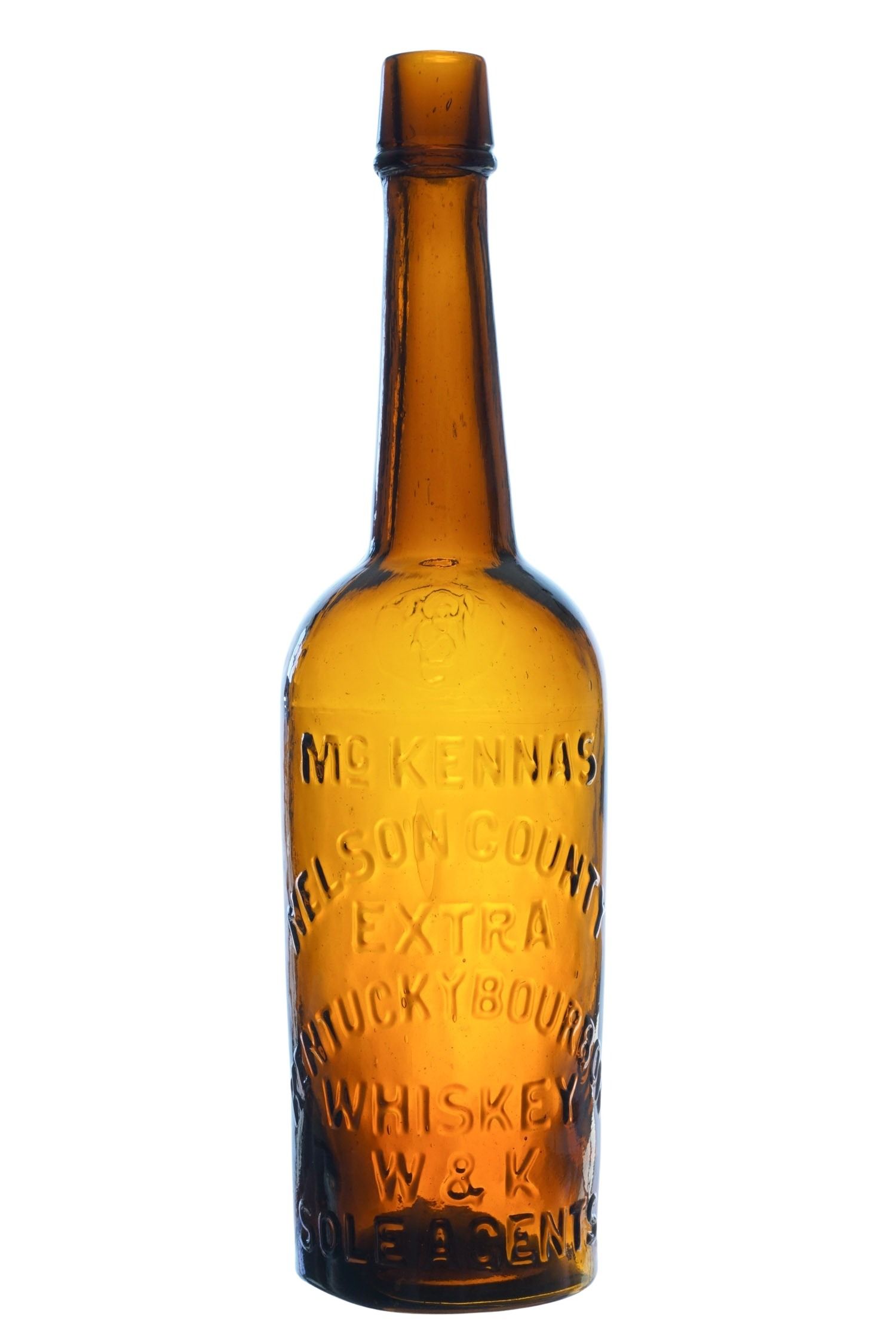
McKennas Nelson County Extra Kentucky Bourbon
Circa 1874–1880s, applied top, fifth. Another popular full face embossed Western whiskey. The McKenna's have long been a favorite among collectors due to the extensive embossing, classic Western appearance, and overall collectability. Many examples suffer from weak strikes, making well struck specimens especially desirable.
Description & Condition: Good strike, old amber color showing a subtle olive tone, unlike most which are a typical beer bottle amber color. No condition issues. A nice example.
Min. Bid $400 - Est. $800–$1,500
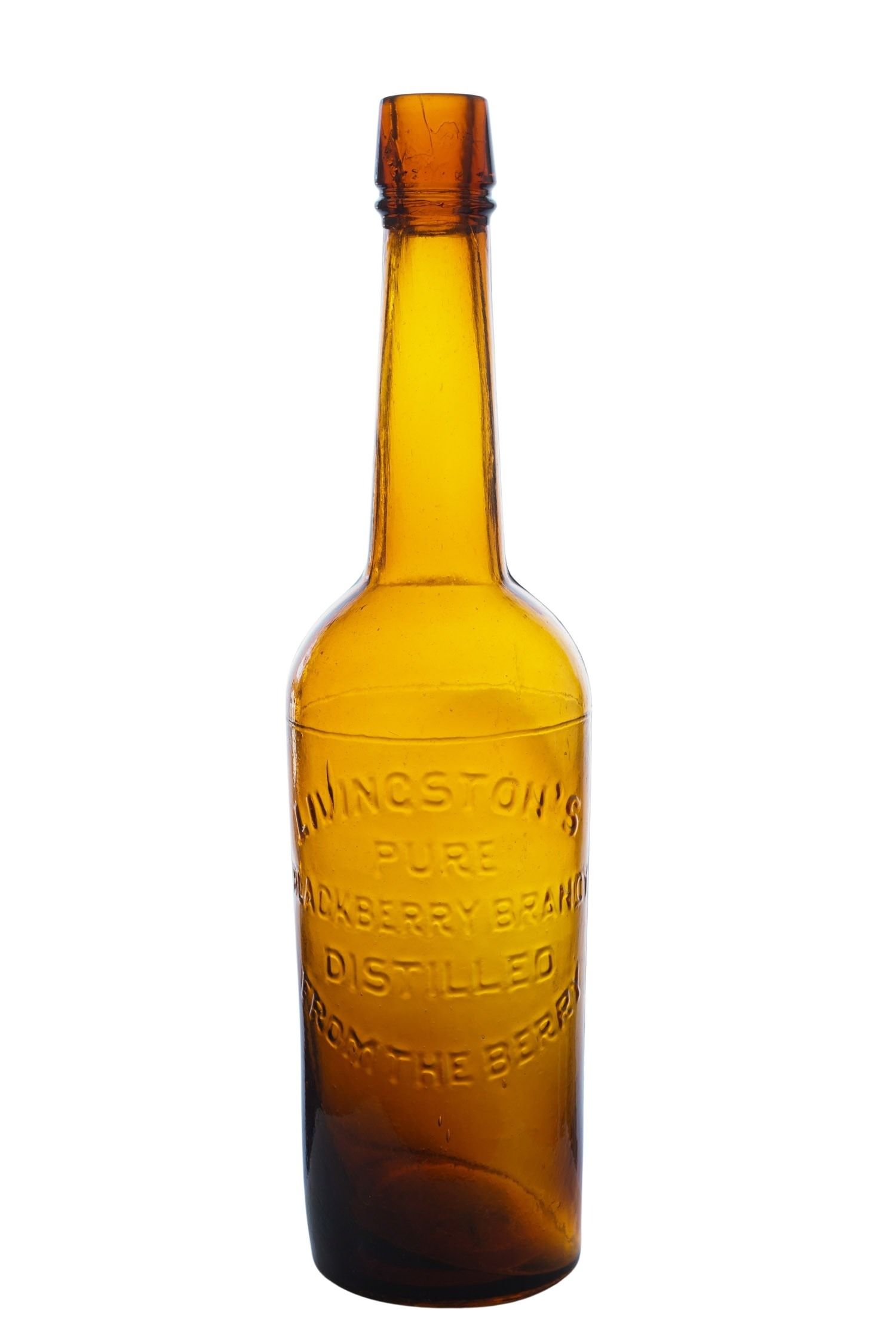
Livingston's Pure Blackberry Brandy Distilled From The Berry
Circa 1877–1884, applied top, sixth. A fairly rare Western sixth with extensive embossing and about as many curved Rs as can be found on a Western bottle. It sounds like a product that should have been a success, but the scarcity of the bottle suggests otherwise. Whatever the reason, relatively few examples were produced or survived, and the bottle remains elusive today, with hardly any new examples coming to light in recent decades.
Description & Condition: Medium amber with a solid strike. Six ray star on the base. Lighter color than many other examples.
Min. Bid $300 - Est. $600–$1,200
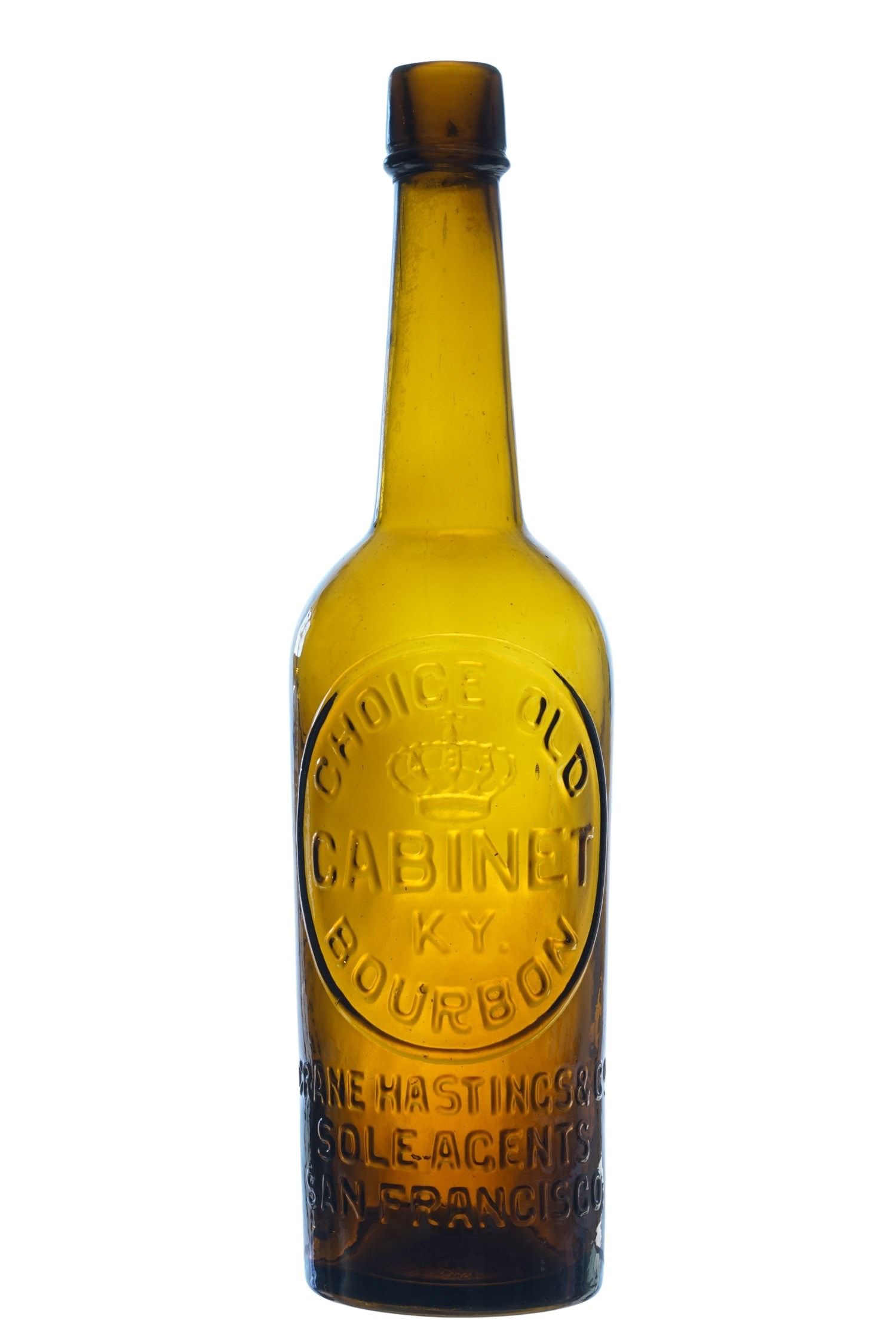
Choice Old Cabinet K.Y. Bourbon
Circa 1878–1890, applied top, fifth. A popular Western fifth featuring bold, extensive embossing. Although the trademark for this design was not filed until 1885, advanced West Coast diggers have reported recovering examples from late 1870s and early 1880s contexts on numerous occasions. It is therefore likely that Crane, Hastings & Co. had been using the design for several years prior to officially registering the trademark. The brand appears to have been particularly popular in Washington State, where a surprising number of examples have been dug. Applied–top examples occur in two molds: an earlier variant characterized by flatter, rounder embossing, richer color variations, and a smaller applied top, and a later reworked mold with sharper embossing, less color variation, and a larger, distinctly mid–to–late–1880s style top. Finding an example that combines a strong strike with any shade of yellow or olive is extremely difficult.
Description & Condition: Strong strike in the early mold. Great color with a pleasing amount of olive. Appears to have been professionally cleaned. Minor interior stain remains in the neck and shoulder. A few insignificant surface impacts, the largest measuring approximately 1/16" on the U in Bourbon, along with two smaller flakes on the base edge.
Min. Bid $1,000 - Est. $2,000–$4,000
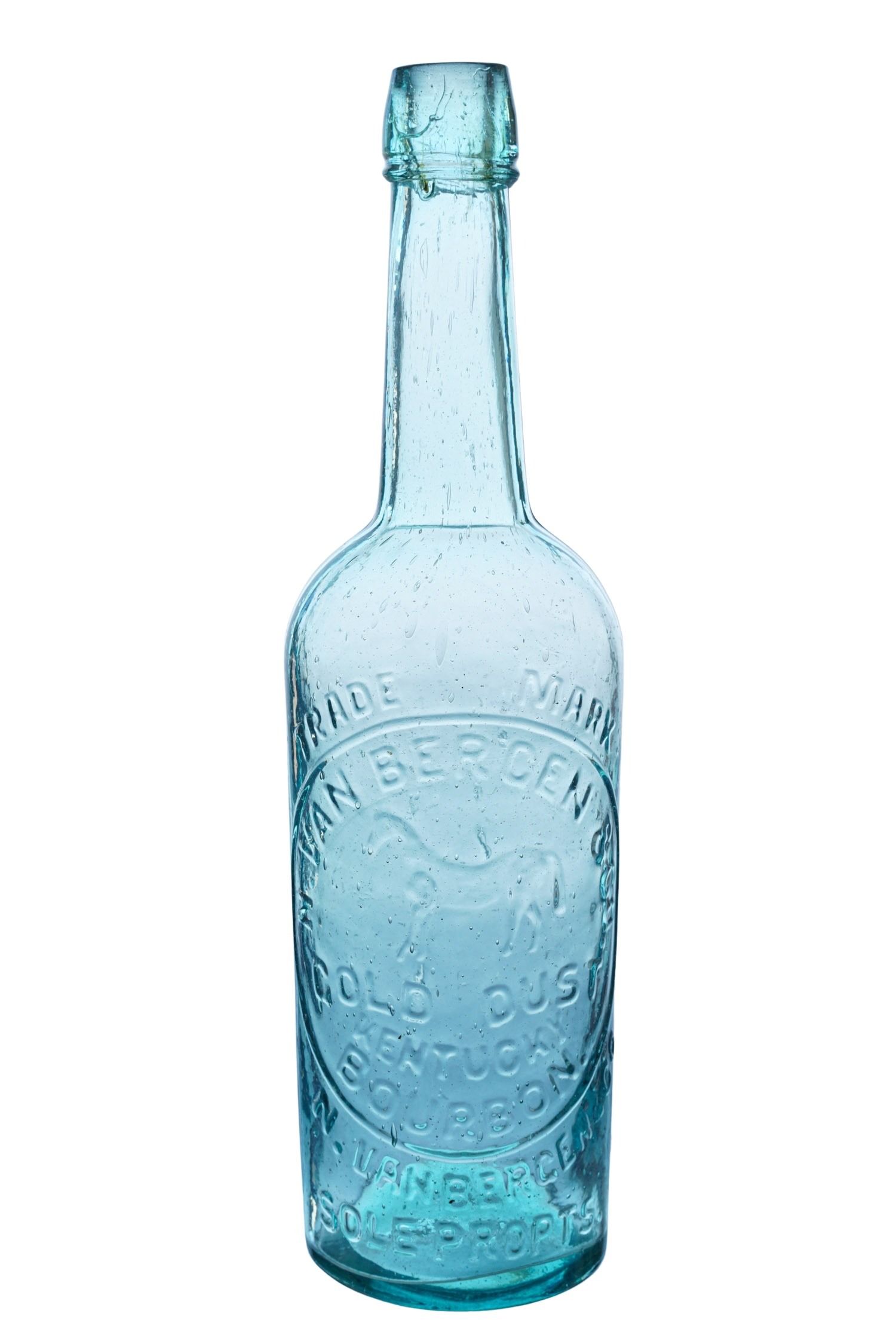
Gold Dust Kentucky Bourbon N. Van Bergen Sole Propts.
Circa 1880–1885, applied top, fifth. A popular Western whiskey fifth that has remained a collector favorite for decades. This is the third Gold Dust variant, likely introduced around 1880 when N. Van Bergen & Co. became the sole proprietor of the brand. These bottles are notorious for weak embossing and condition issues, making this example particularly desirable.
Description & Condition: Strong strike with abundant bubbles and a nice large top. Possibly professionally cleaned.
Min. Bid $600 - Est. $1,200–$2,000
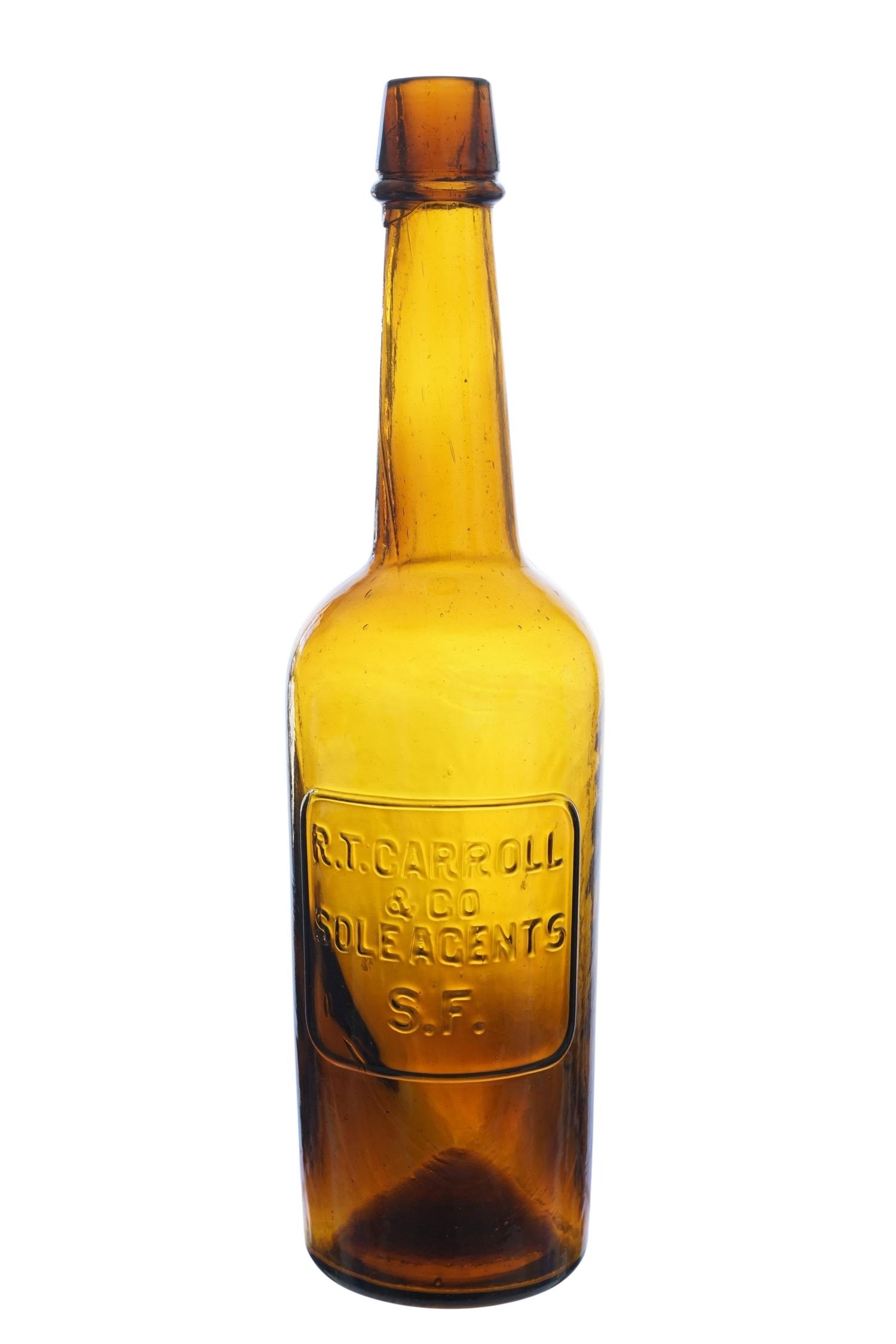
R.T. Carroll & Co. Sole Agents S.F.
Circa 1875–1882, applied top, fifth. A very rare 5th with only a handful of known examples. An 1880 advertisement for R.T. Carroll shows the company was marketing several brands of Kentucky whiskey, including Kentucky Cabinet, Imperial, and Park Rye. Another advertisement from 1881 notes that the firm was the sole Pacific Coast agent for Robertson County Tennessee Whiskey. Perhaps that exclusive agency prompted the production of this slug plate 5th.
Description & Condition: Light amber color transitioning to honey amber in the shoulders. A large swirl passes through the slug plate. Regarded as the finest known example of this rare bottle.
Min. Bid $1,500 - Est. $3,000–$6,000
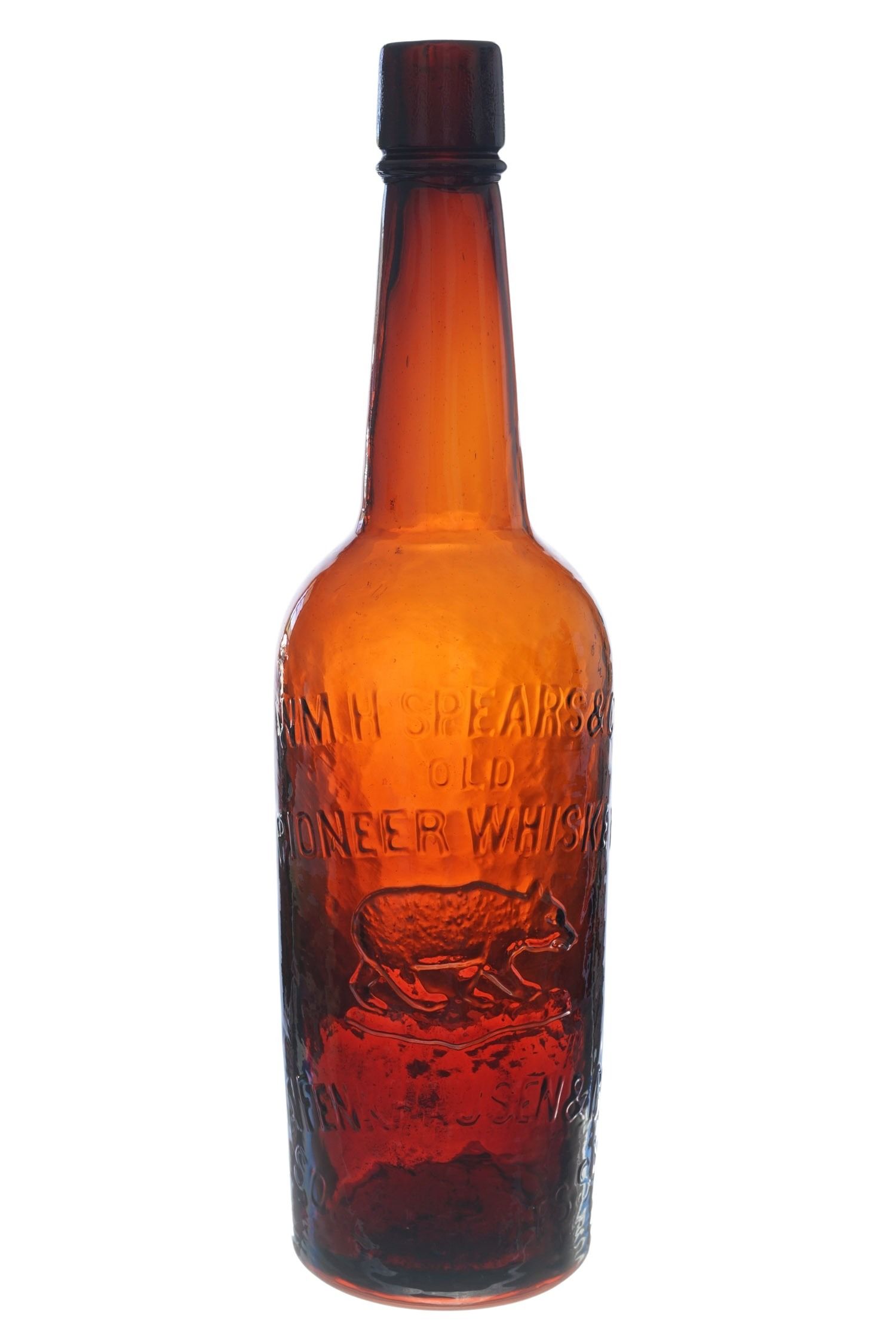
WM. H. Spears & Co. Old Pioneer Whiskey
Circa 1890s, applied top, fifth. One of the rarest of all the Fenkhausen fifths, this is the highly desirable German red whittled variant. These bottles are prized for their heavy whittle and beautiful shades of red. This particular variant appears to have enjoyed greater popularity in the logging regions of the Pacific Northwest, where a number of broken and whole have been found. With its boldly embossed walking bear and prominent Old Pioneer name, this bottle is likely to remain high on the list of any serious Western whiskey collector.
Description & Condition: Red amber color with abundant whittle and a strong strike. A beautiful German "red whittle" fifth.
Min. Bid $750 - Est. $1,500–$3,000
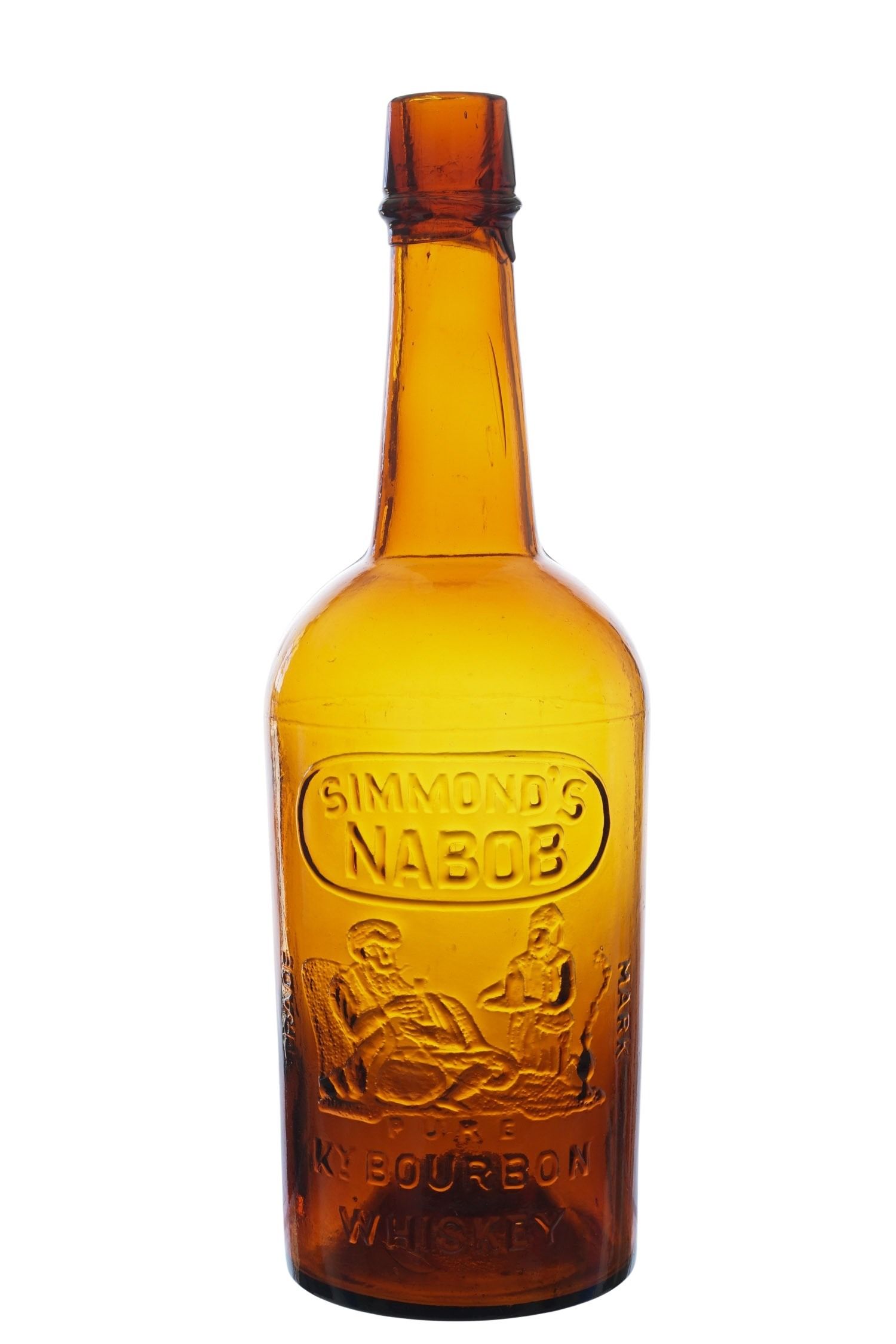
Simmond's Nabob KY Bourbon Whiskey
Circa 1879–1887, applied top, fifth. The rarest of all the picture Nabob fifths. While the entire bottle was produced from a different mold, the easiest way to identify this variant is the "Simmond's Nabob" embossing enclosed within a circle. In addition, the embossing exhibits the distinctive Western curved Rs found on many Western blown bottles of the era. The striking image of a Nabob smoking a hookah is among the most memorable Western whiskey designs of the nineteenth century. The term "Nabob" was commonly used to describe a wealthy or influential person and was likely chosen to convey an image of prosperity and refinement. An exceptionally rare Western fifth that may not surface again for many years.
Description & Condition: Light amber color. Large drip off the applied top. Paper-thin bubble, about 1/8", on the interior edge of the lip, likely opened during manufacture. Small patch of wear on the reverse, approximately 5/8" long.
Min. Bid $1,000 - Est. $2,000–$4,000
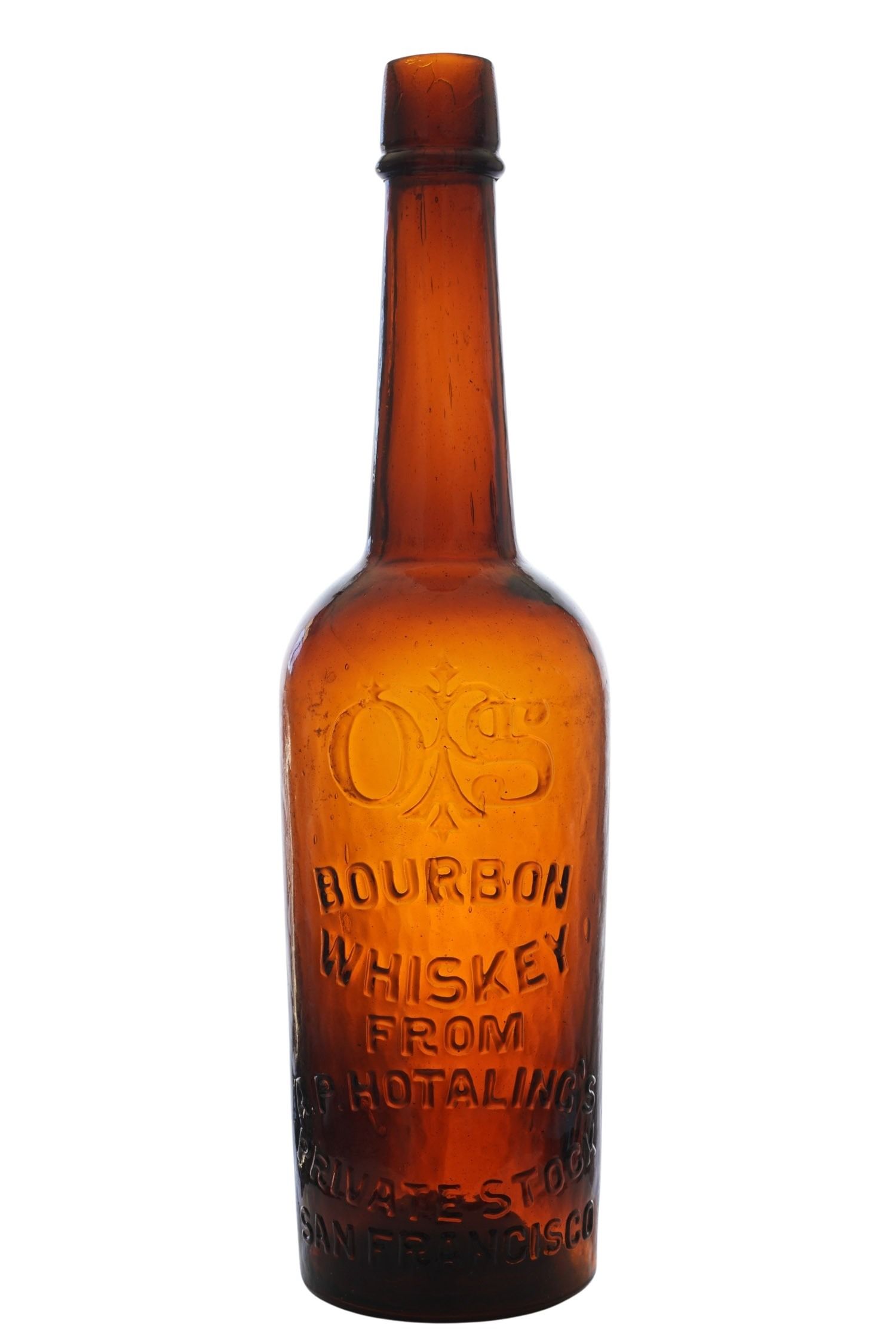
O.P.S Bourbon Whiskey A.P. Hotaling & Co.
Circa 1879–1885, applied top, fifth. A boldly embossed Western fifth featuring a large and ornate monogram that makes it one of the more distinctive Hotaling whiskey bottles. Like many Western fifths of the era, examples have been found across several Western states, with concentrations in early mining camps and logging communities. The combination of extensive embossing, Western history, and broad frontier distribution has long made this one of the more popular Hotaling 5ths among collectors. This is the rare variant lacking the "Old" before "Private Stock." There are believed to be less than 5 known examples of this variant. Thomas # 53.
Description & Condition: Amber color with a strong strike and abundant whittle. Very faint exterior patina and a minor area of wear on the front left shoulder.
Min. Bid $1,000 - Est. $2,000–$4,000
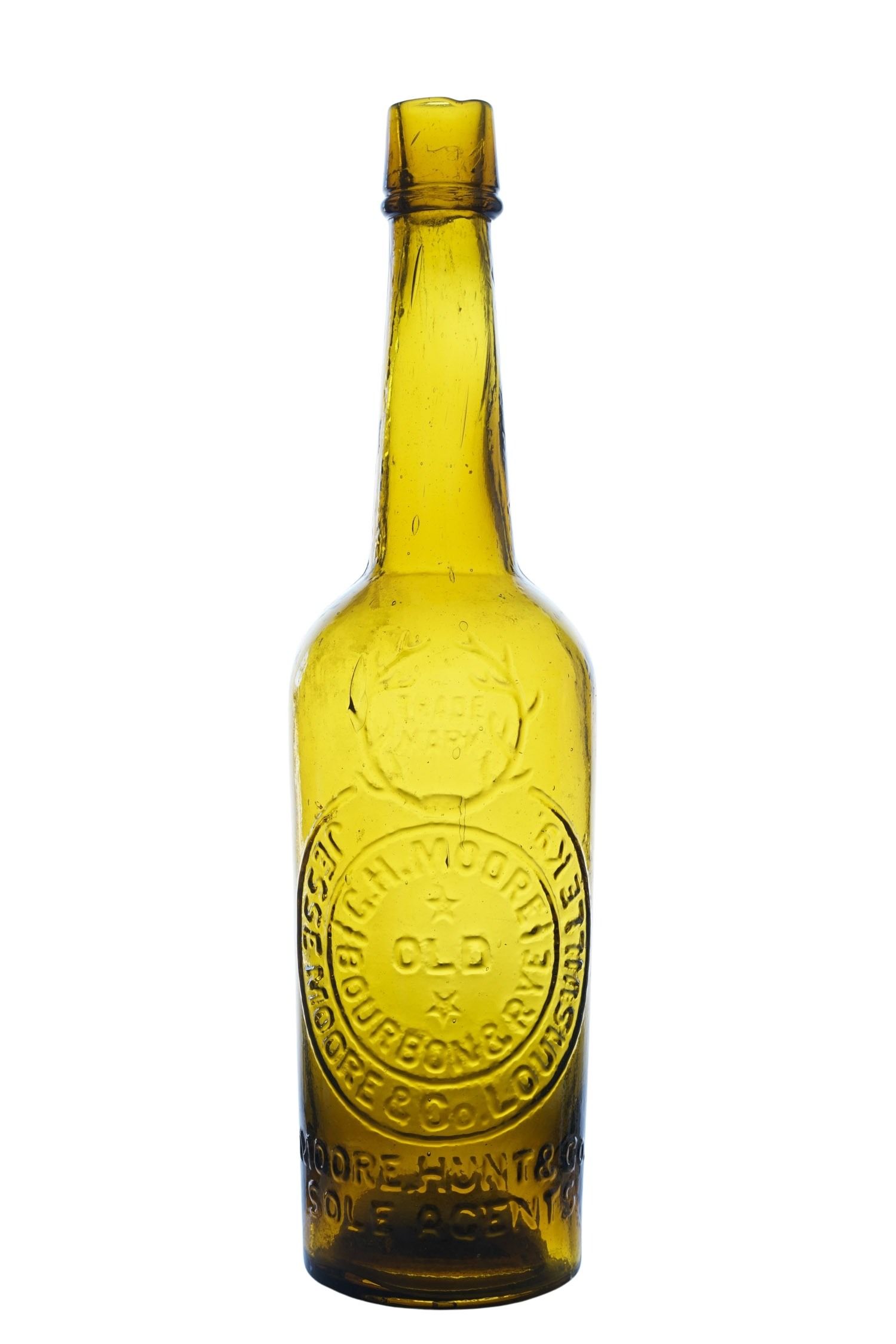
Jesse Moore Old Bourbon
Circa 1880–1885, applied top, fifth. This is the second mold of the Jesse Moore fifths, distinguished by the vent mark on the shoulder. Jesse Moore began as a Louisville liquor dealer before expanding into whiskey production, eventually building one of the best known bourbon brands in the American West. Its iconic stag antlers make it one of the most recognizable Western whiskey bottles. An 1890s trademark filing states the design had been in use since 1860. Distributed through San Francisco by Moore, Hunt & Co., Jesse Moore whiskey became one of California’s most recognizable bourbon brands by the early 1880s. As a testament to the brand’s popularity, Jesse Moore bottles have been excavated in nearly every Western state. While Jesse Moore fifths are obtainable, examples in anything other than medium or dark amber can be extremely difficult to find.
Description & Condition: Vented variant. Bright yellow color with a touch of citron. Never cleaned, retaining a tiny amount of interior residue. An exceptional example that was in the Ken Schwartz collection for many years.
Min. Bid $250 - Est. $500–$1,000
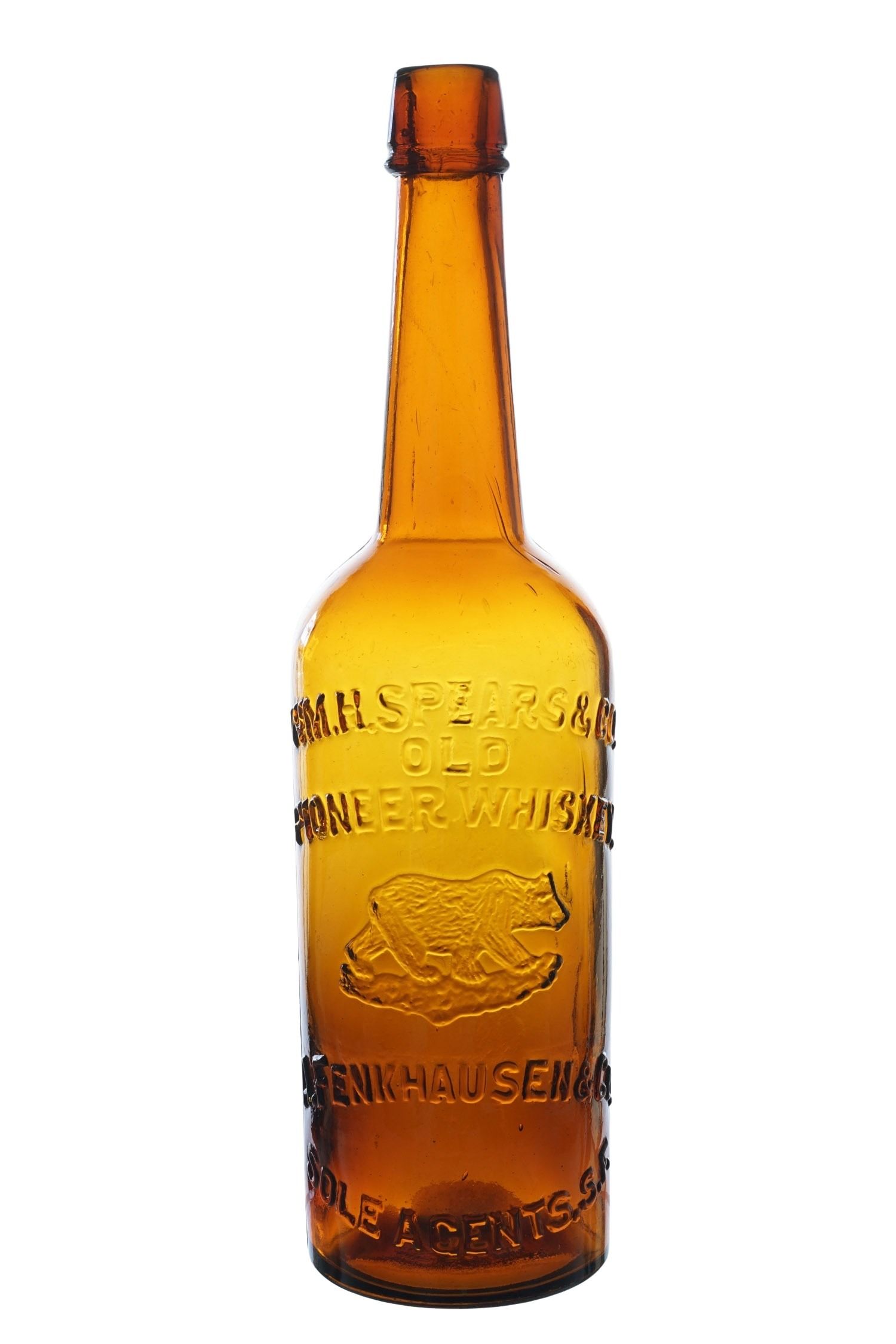
WM. H. Spears & Co. Old Pioneer Whiskey A. Fenkhausen & Co.
Circa 1881–1886, applied top, fifth. This is the "One Name Bear" variant, made after Fenkhausen & Braunschweiger dissolved their partnership in 1881. These fifths have long been popular with collectors due to the embossed walking bear and the Pioneer Whiskey name, both of which immediately bring to mind California's frontier past. One of the more recognizable pictorial whiskey bottles from the American West. These bottles are very difficult to find with a strong strike.
Description & Condition: Honey amber, very strong strike. A top example.
Min. Bid $750 - Est. $1,500–$3,000
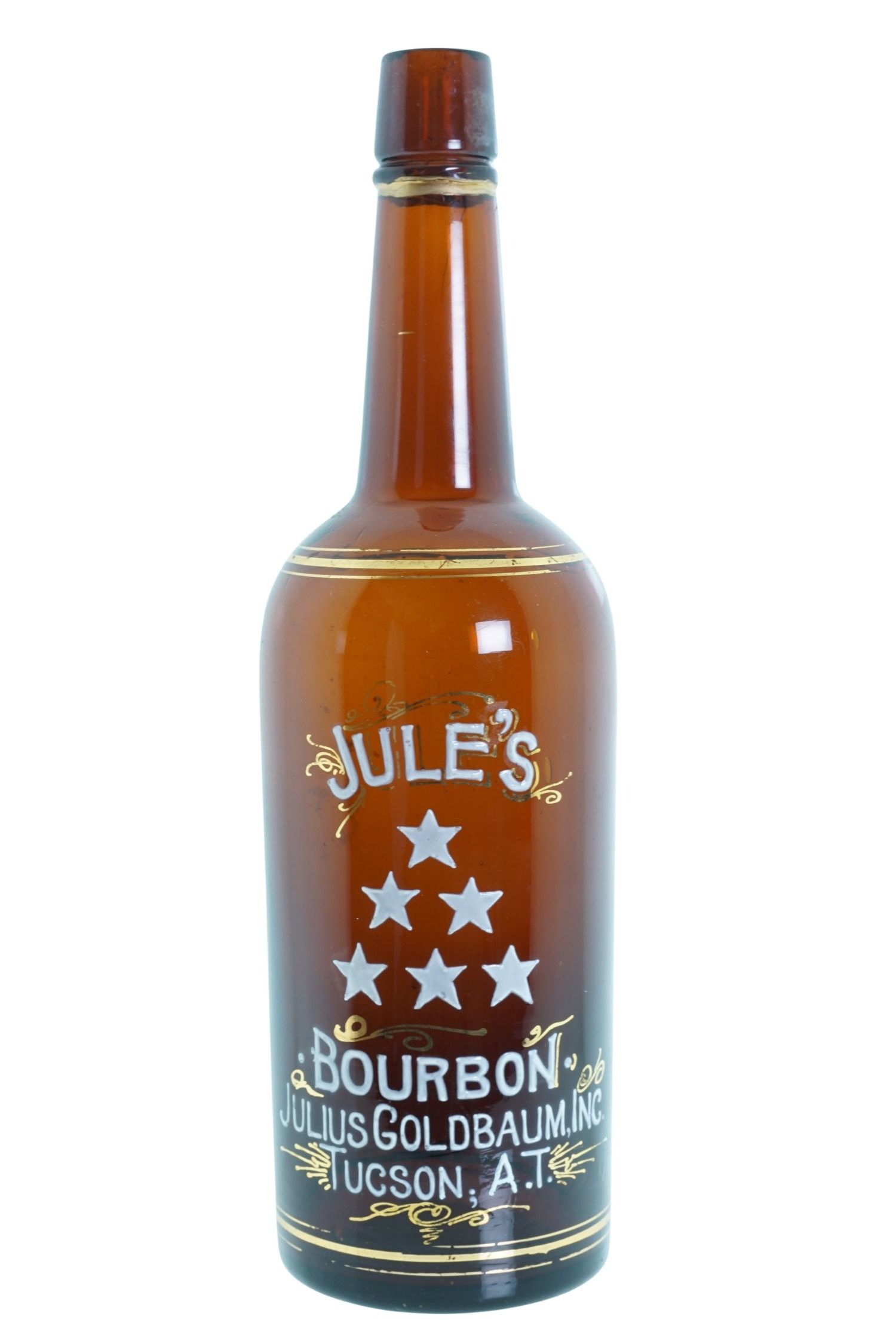
Jule's Bourbon Julius Goldbaum, Inc. Tucson, A.T.
Circa 1887–1903, quart, 12". Julius Goldbaum was one of Tucson's best known wholesale liquor dealers during Arizona's territorial period. This impressive back bar is embossed "A.T." for Arizona Territory, indicating it was produced prior to Arizona achieving statehood in 1912. Remarkably, nearly all known examples trace their origins to Goldbaum's former Tucson residence, where three examples were discovered in the basement during the 1940s along with business papers, labels, and other artifacts relating to his liquor business. Today, only a single mint example is known, underscoring the extreme rarity of this bottle in any condition.
Description & Condition: Professionally replaced top. The workmanship is exceptional, and the repair is extremely difficult to detect with the naked eye. Some loss to the original gold detailing. Overall an attractive example, with a possible touch-up to the white enamel in the A in A.T.
Min. Bid $1,500 - Est. $3,000–$5,000
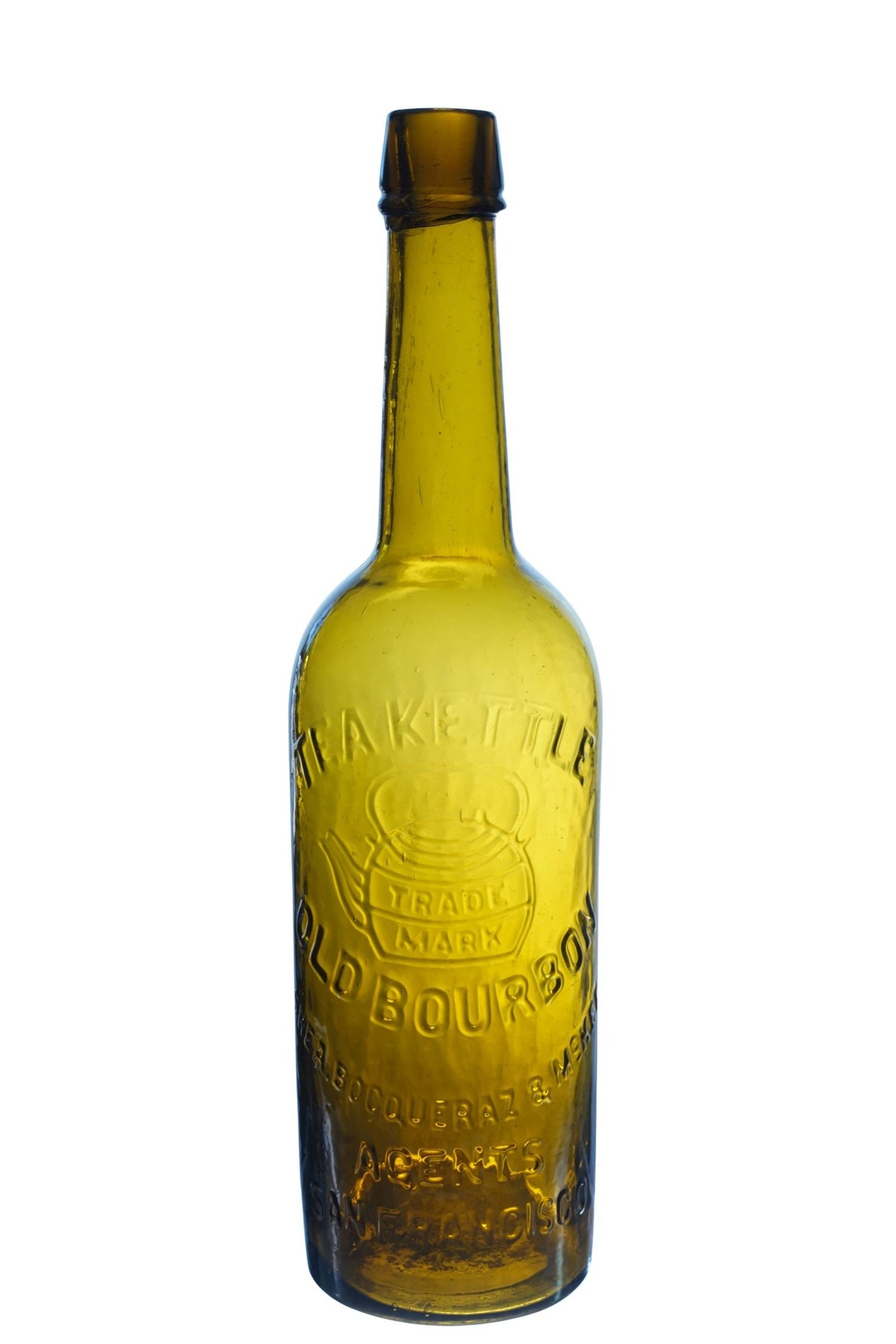
Tea Kettle Old Bourbon
Circa 1871–1880s, applied top, fifth. Perhaps the best known pictorial whiskey fifth of the Wild West era. Examples have been found throughout the American West, though the greatest concentration has come from Nevada, particularly the Comstock region. The whiskey sold in these bottles was produced by the famous Tea Kettle Distillery in Trimble County, Kentucky. The distinctive embossed tea kettle served as the brand's trademark and, much like the horse on a Gold Dust or the antlers on a Jesse Moore, helped the bottle stand out on a crowded saloon shelf. These bottles are highly collectible because they occur in a wide range of colors, from various shades of amber and yellow to yellow–green and olive. Despite their popularity, it can be surprisingly difficult to find examples combining color with a strong strike.
Description & Condition: A yellow olive shade with a good strike and abundant whittle. Retains a tiny amount of interior residue.
Min. Bid $1,000 - Est. $2,000–$4,000
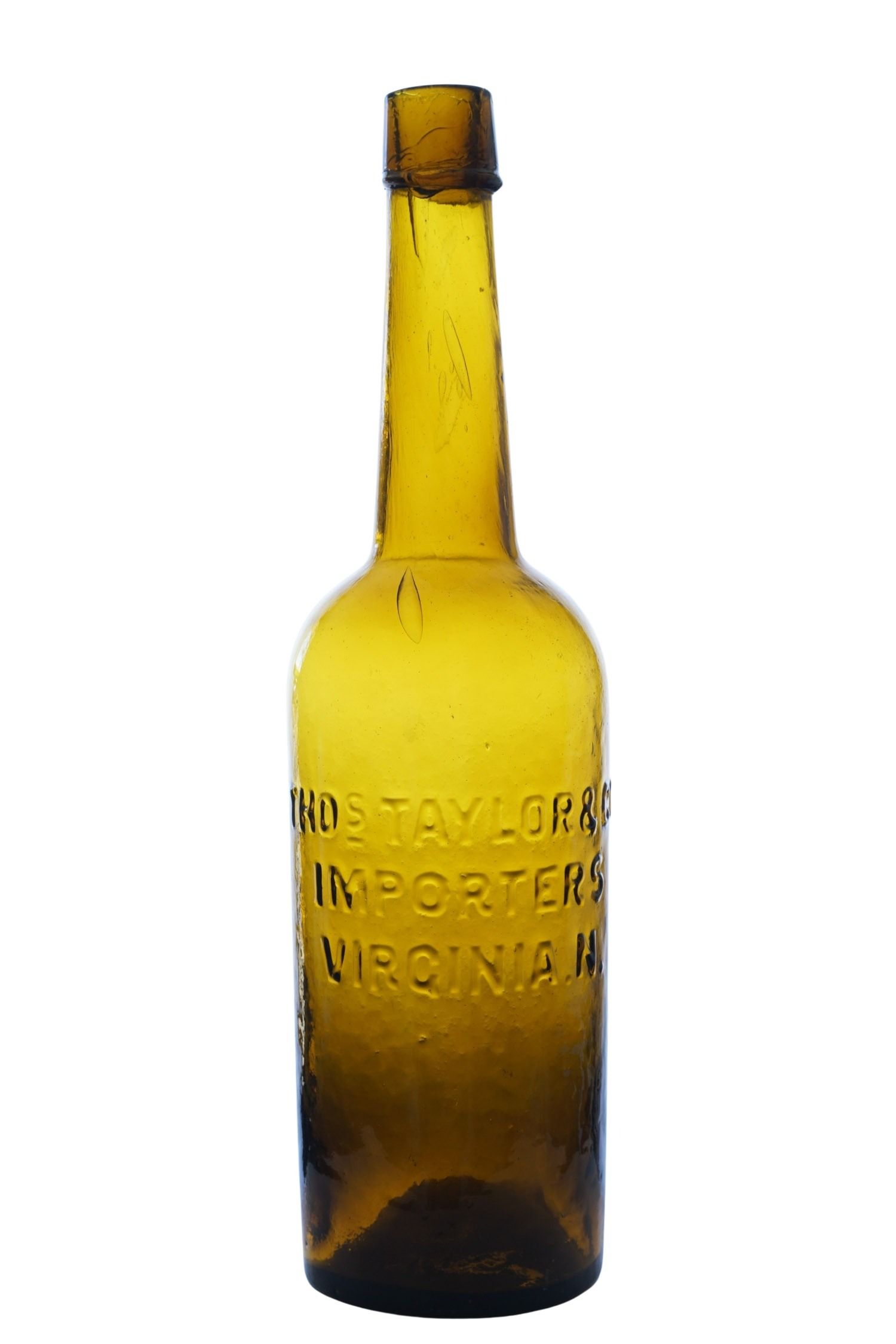
Thomas Taylor & Co Importers Virginia, N.
Circa 1870–1874, applied top, fifth. One of the most famous whiskey bottles of the Comstock era, produced in both fifth and sixth sizes. Approximately 15 fifths and 7 sixths are believed to exist, making either size a rarity today. Thomas Taylor was an early West Coast liquor merchant who arrived in California during the Gold Rush era and later established himself in both San Francisco and Virginia City. His business prospered during the height of the Comstock mining boom, supplying liquor to one of the wealthiest and most influential mining regions in the American West. Taylor's bottles are highly sought after for their direct connection to Virginia City and the legendary silver mining history of the Comstock. They are also among a very small group of embossed bottles from the 1860s and 1870s bearing the name Virginia, joining such rarities as the Morrill Citrate, Higgins Ink, and Stephens & Jose gravitating soda.
Description & Condition: Olive amber color with a touch of yellow. Abundant whittle and crude, stippled glass. A beautiful example.
Min. Bid $3,000 - Est. $6,000–$12,000
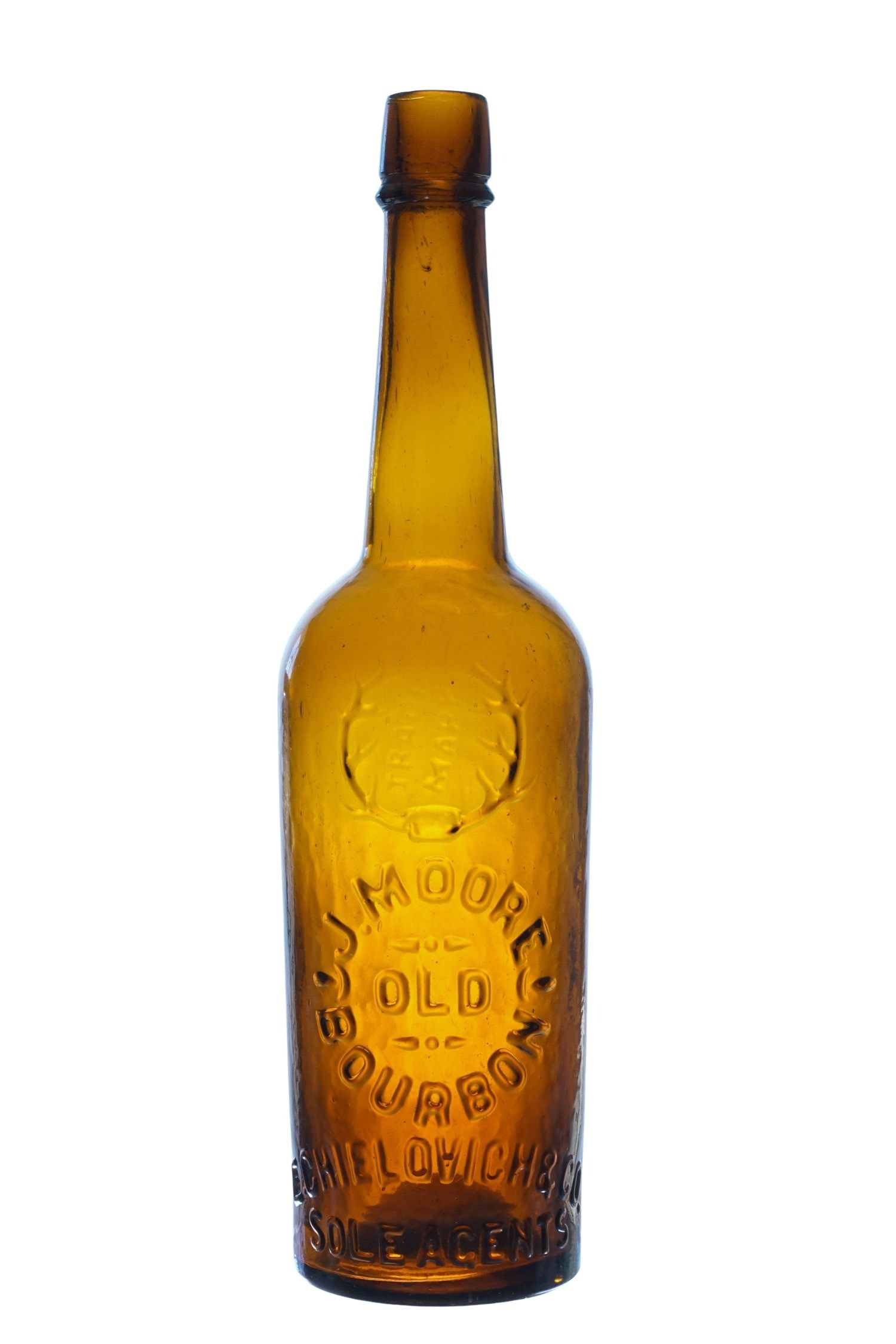
J. Moore Old Bourbon E. Chielovich & Co.
Circa 1871–1875, applied top, fifth. An iconic Western fifth loaded with bold embossing and the distinctive stag antlers that have made this bottle a favorite among collectors for generations. These bottles simply exude the spirit of the Wild West and rank among the earliest full face embossed whiskey bottles produced in the West. The brand was particularly popular throughout the mining regions of California and Nevada, with examples occasionally turning up as far east as Utah. Few Western whiskey bottles are as instantly recognizable or as sought after by collectors as the J. Moore.
Description & Condition: Medium amber color with a good strike and plenty of whittle. Small 1/8" crushed bubble on the reverse. Very light exterior scratching throughout, heavier on the reverse, likely from being dug and difficult to see except under strong lighting. Possibly professionally cleaned. Overall a solid example.
Min. Bid $1,250 - Est. $2,500–$4,000
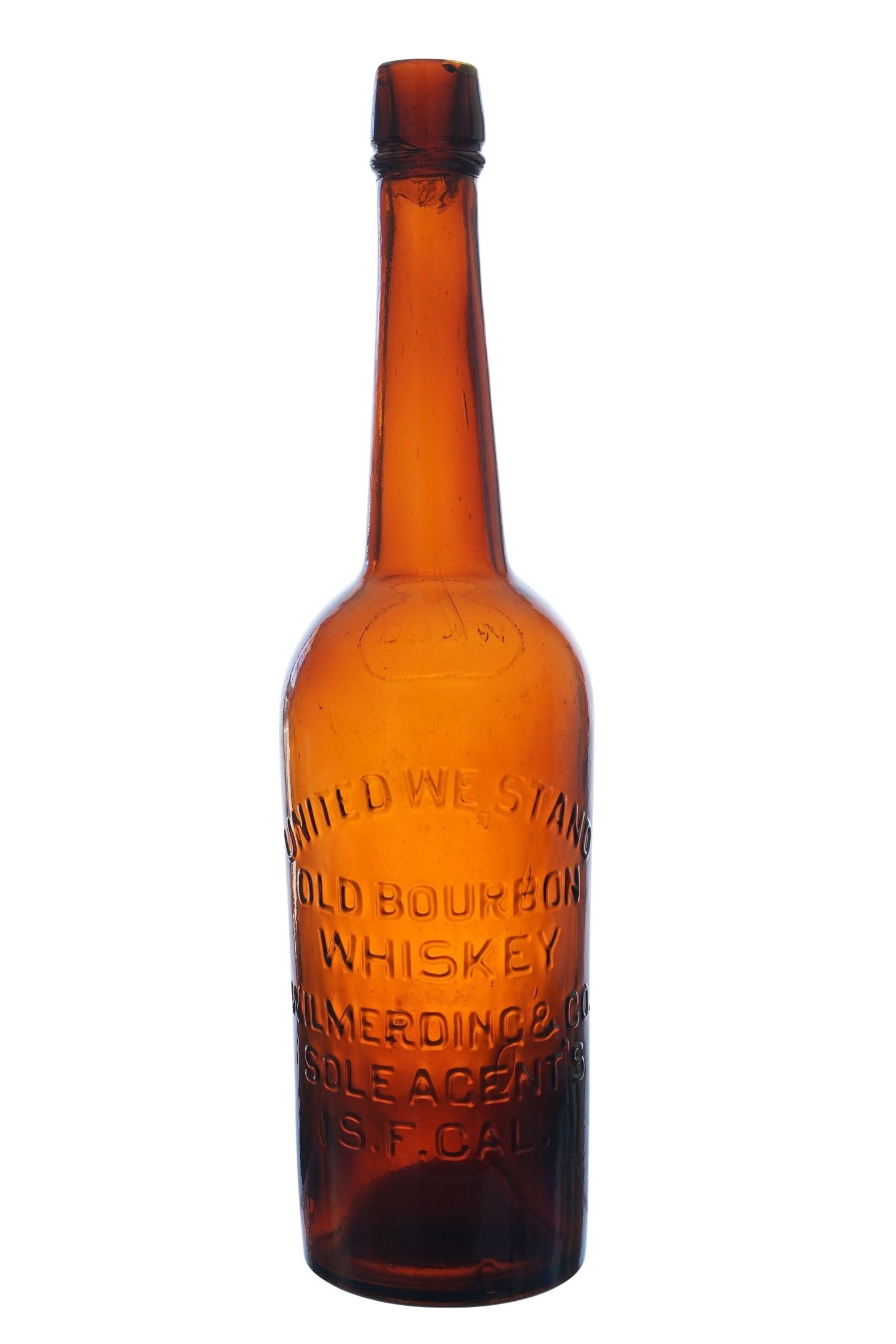
United We Stand Old Bourbon Whiskey Wilmerding & Co.
Circa 1878–1883, applied top, fifth. One of the more popular Western fifths, and for good reason. Beyond the patriotic name, it has been suggested that the brand may have been introduced in response to the national attention surrounding the assassination of President Garfield in 1881. While examples surface from time to time, there are still not enough to satisfy collector demand, with perhaps fewer than 10 examples known. A rare and highly desirable Western fifth with a great name and strong collector appeal.
Description & Condition: Amber color with a good strike. A solid example.
Min. Bid $1,250 - Est. $2,500–$5,000
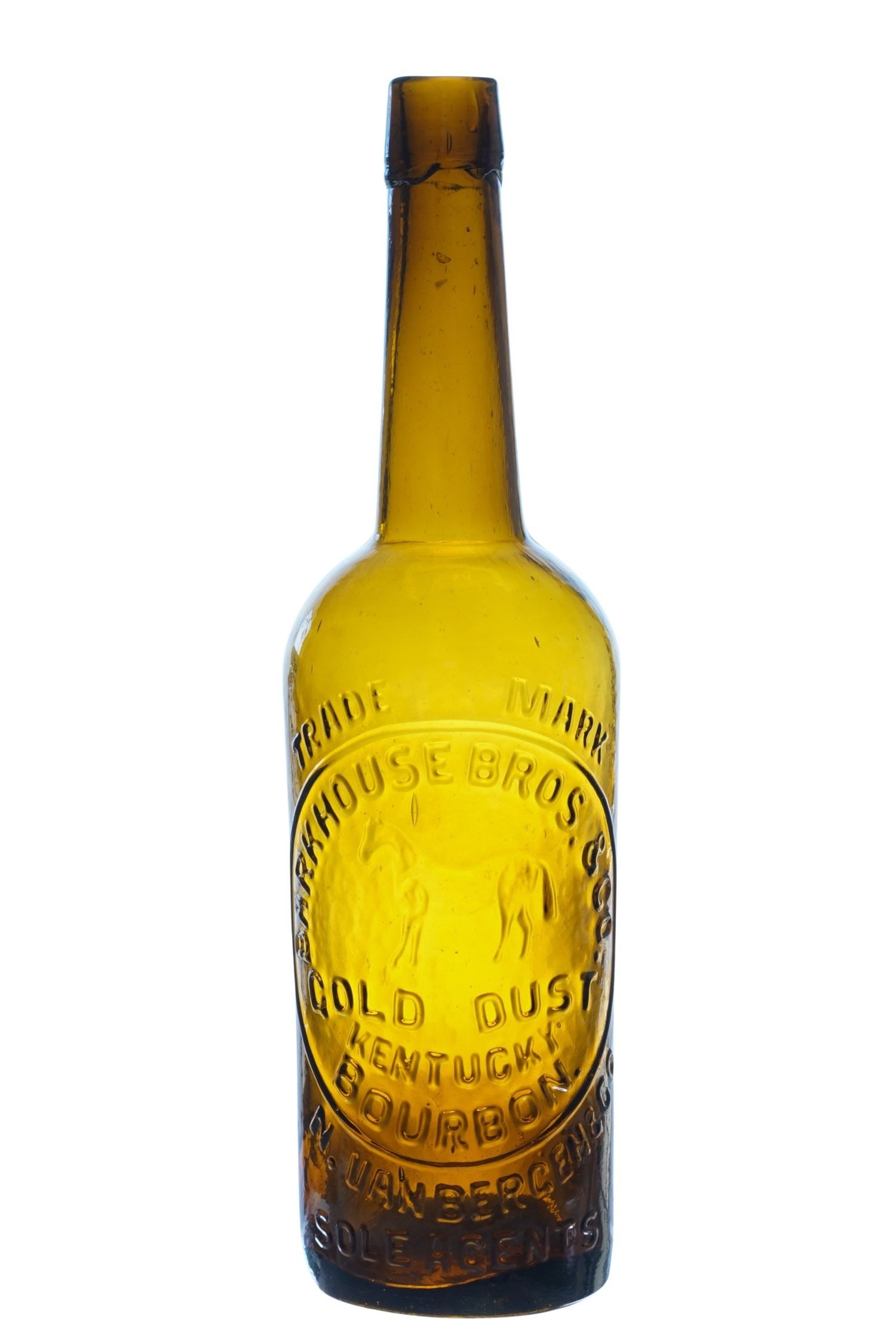
Gold Dust Kentucky Bourbon N. Van Bergen Sole Agents
Circa 1874–1880, applied top, fifth. This is the second variant of the Gold Dust 5th, made after Nicholas Van Bergen took over the company in 1874. There are similar amounts of Johns and Ns, but the N remains slightly rarer. This example was in the famous Ken Schwartz collection for several years before Jeff purchased it a few years ago. An outstanding example loaded with whittle in a beautiful yellow olive color with an unusually small and crude top.
Description & Condition: Honey olive color with a strong strike and abundant whittle. An exceptional example, formerly in the famed Ken Schwarz collection.
Min. Bid $4,000 - Est. $8,000–$15,000
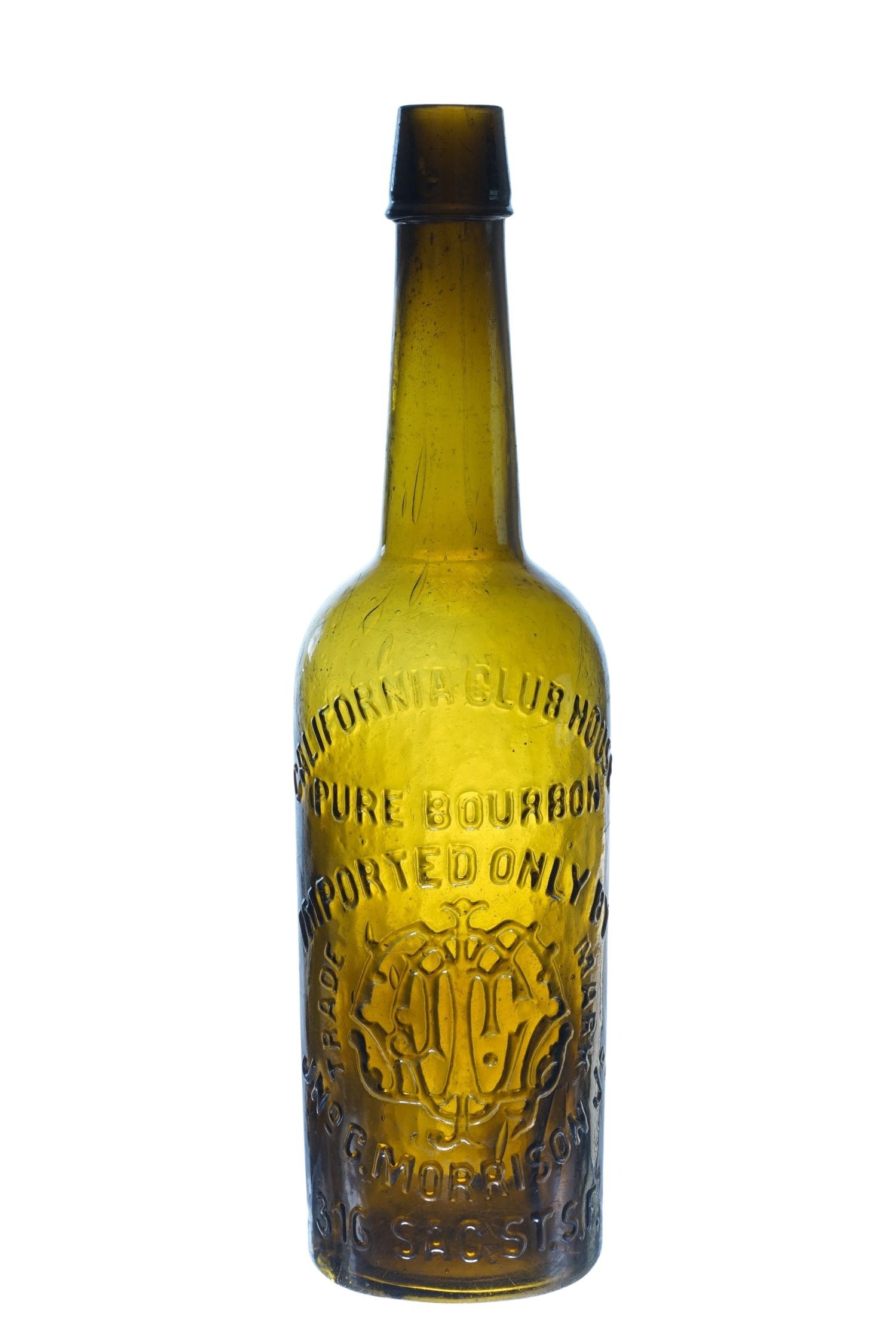
California Club House Pure Bourbon Imported Only By Jno C. Morrison 316 Sac. St. S.F.
Circa 1871–1873, applied top, fifth. John C. Morrison Jr. was one of California's early pioneers arriving in San Francisco in June 1849 during the Gold Rush. He briefly mined at Horseshoe Bar before moving to Sacramento and eventually returning to San Francisco, where he established himself in the liquor trade during the 1860s. By 1872, Morrison was advertising his California Club House brand. Although rare, these bottles enjoyed a wide distribution and have been found in San Jose, Marin County, Portland, and, of course, Nevada, where multiple examples have been discovered. After more than 60 years of searching, bottle collectors can account for only about ten examples. Considered by many to be the finest Western whiskey fifth, owing to its head-to-toe embossing, iconic name, early age, and highly coveted street address. There are believed to be about 5 amber, 3 green, and 2 olive examples known. This is the famous example once owned by the legendary John Thomas, who purchased it from Frank Shoengarth shortly after Frank dug it in Columbus, Nevada, in 1970. Frank had dug two olive examples: this example and another that was missing its neck and was later repaired.
Description & Condition: Olive amber with heavy whittle and an outstanding strike. Moderate scratching and scattered surface impacts, likely the result of spending nearly a century in the Nevada desert. Includes a small 1/16" impact with minor glass loss on the C in C. Morrison, along with a few other harmless surface impacts measuring approximately 1/32" to 1/16". While not perfect, it is about as well preserved as one could reasonably expect for a bottle that survived the rigors of the Wild West before lying buried in the Nevada desert for nearly a century.
Min. Bid $5,000 - Est. $10,000–$20,000