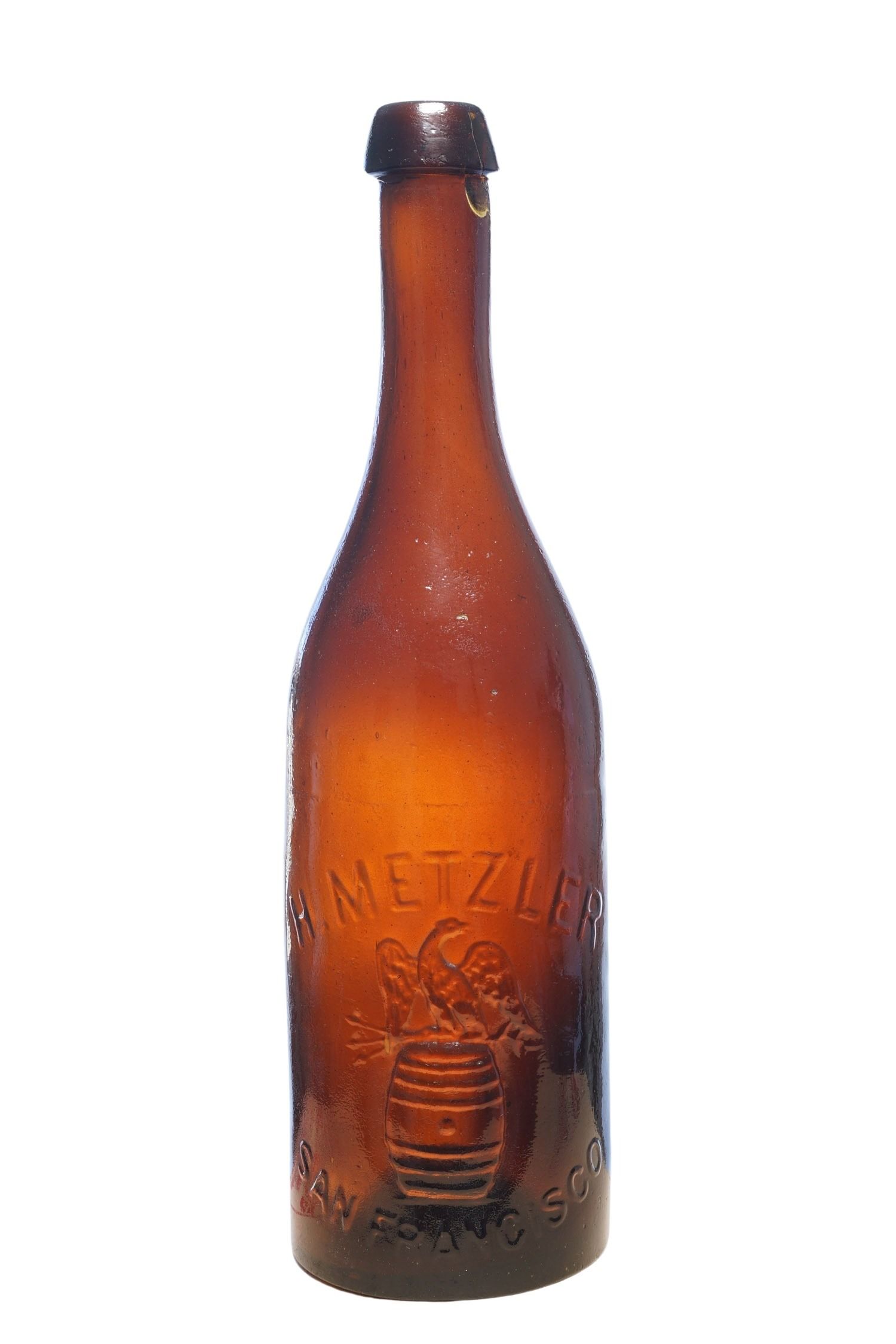
H. Metzler San Francisco
Circa 1885–1887, applied top, quart. An extremely rare beer featuring a fantastic embossed eagle perched atop a barrel. Herman Metzler was listed as an agent for the San Francisco Stock Brewery in 1885, and by 1887 was operating as a beer bottler under his own name. This is another of the coveted Western quart beers from the mid to late 1880s that is seldom offered for sale, with only about seven examples known. As is often the case with these early beers, most known examples exhibit condition issues ranging from lip chips and bruises to more significant damage, making high-grade examples particularly difficult to acquire. Considered by many collectors to be the best-looking and most desirable of all the early Western beers.
Description & Condition: Dark amber color. Surface bruise approximately 3/4" wide extending from the top down into the neck, a 1/4" bruise on the edge of the base, and a potstone with an associated 1/4" check in the shoulder. Regardless, a very difficult bottle to acquire and in better condition than most known examples.
Min. Bid $2,000 - Est. $4,000–$8,000
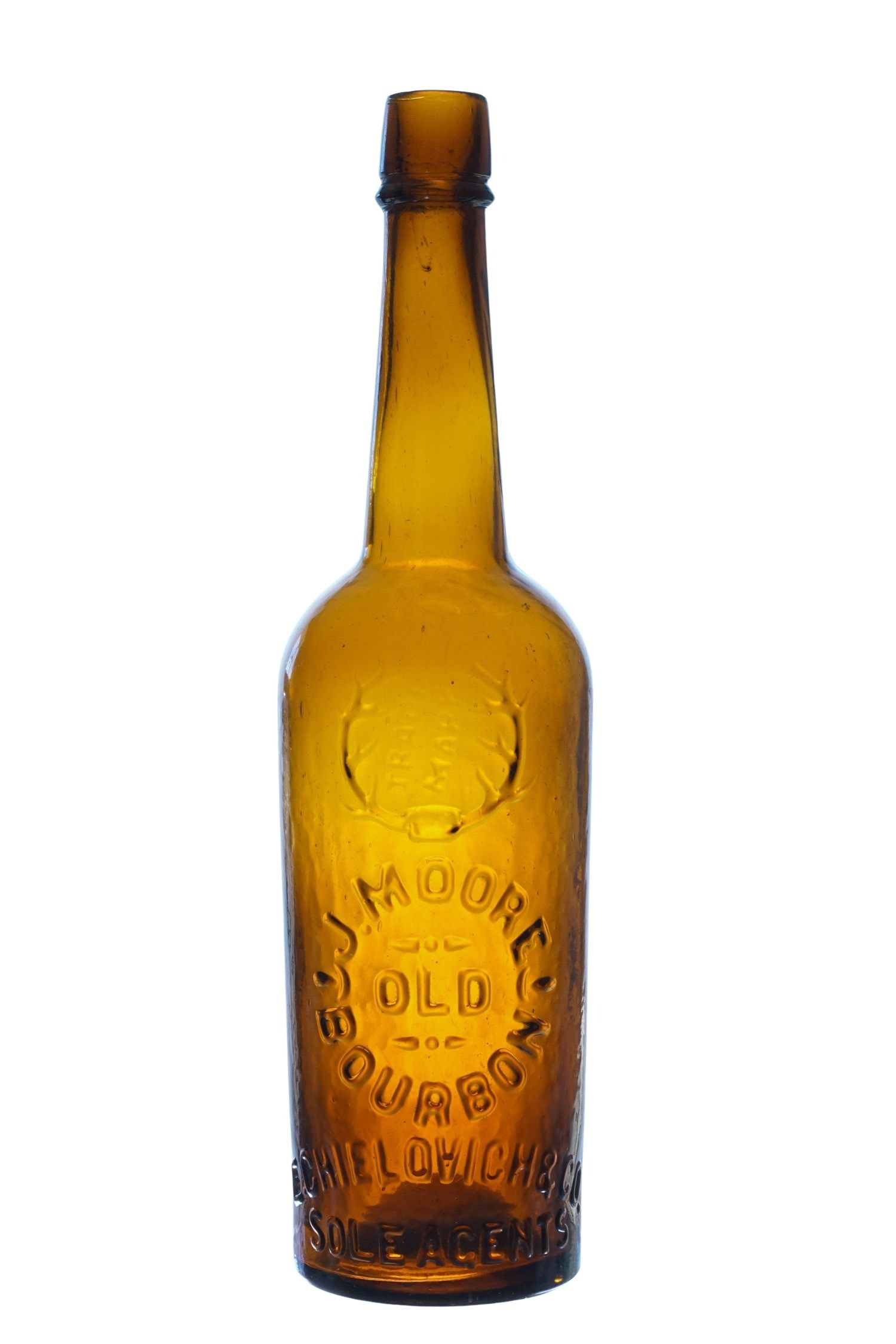
J. Moore Old Bourbon E. Chielovich & Co.
Circa 1871–1875, applied top, fifth. An iconic Western fifth loaded with bold embossing and the distinctive stag antlers that have made this bottle a favorite among collectors for generations. These bottles simply exude the spirit of the Wild West and rank among the earliest full face embossed whiskey bottles produced in the West. The brand was particularly popular throughout the mining regions of California and Nevada, with examples occasionally turning up as far east as Utah. Few Western whiskey bottles are as instantly recognizable or as sought after by collectors as the J. Moore.
Description & Condition: Medium amber color with a good strike and plenty of whittle. Small 1/8" crushed bubble on the reverse. Very light exterior scratching throughout, heavier on the reverse, likely from being dug and difficult to see except under strong lighting. Possibly professionally cleaned. Overall a solid example.
Min. Bid $1,250 - Est. $2,500–$4,000
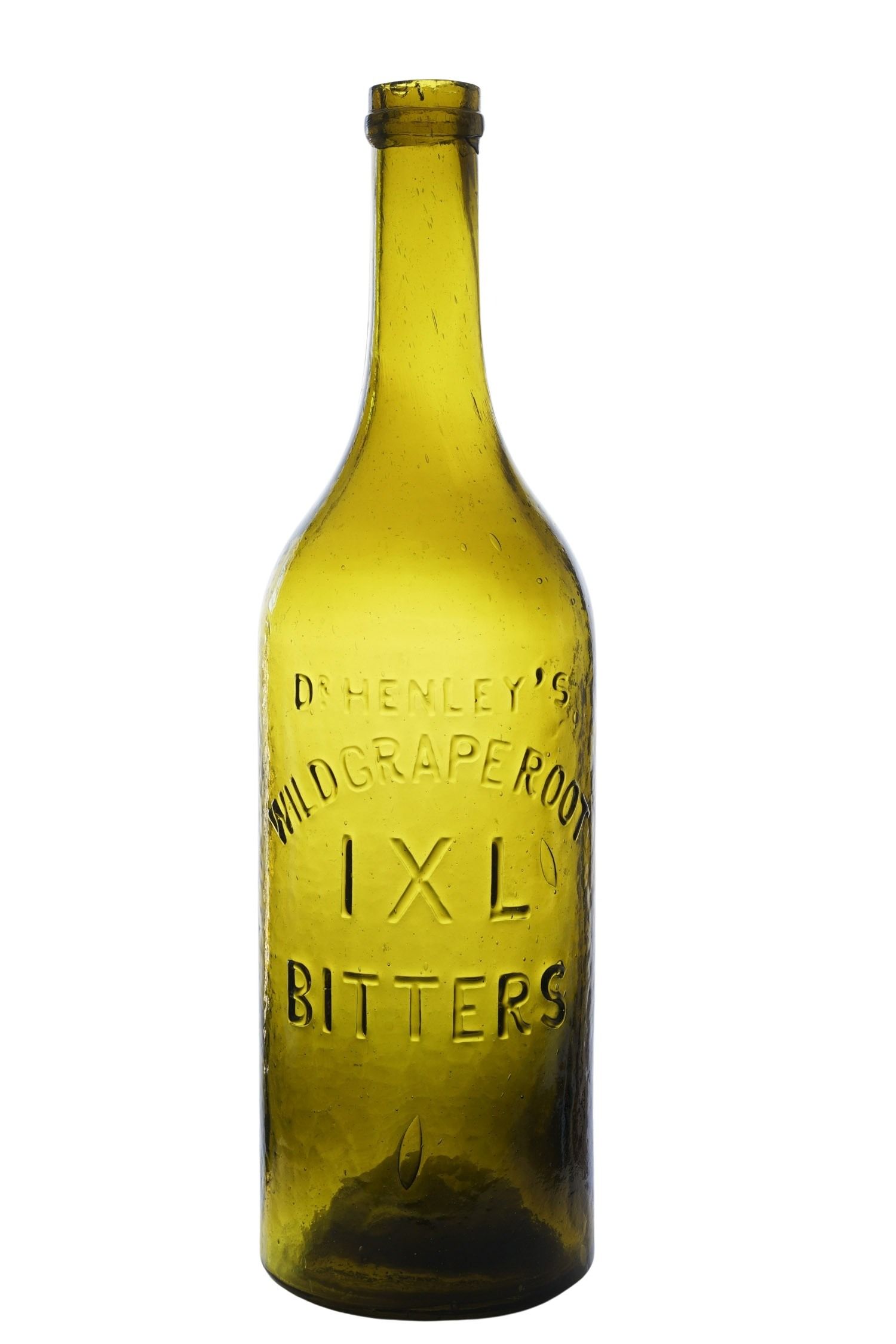
Dr. Henley’s IXL Wild Grape Root Bitters
Circa 1868–1873, applied top, 12". First variant. Without a doubt, this is the most famous of all the Dr. Henley's products. This is the earliest variant of the I.X.L. Bitters, lacking the circle around "I.X.L.," and is highly sought after by collectors for the wild colors and glass crudities in which it is often found. Introduced during the late 1860s, the I.X.L. Bitters would become Henley's flagship product and one of the best known California bitters of the nineteenth century. Today it remains a cornerstone bottle in advanced Western bitters collections and is eagerly sought whenever a quality colored example comes to market.
Description & Condition: Medium yellow olive. Heavy whittle. Minor 3/16" chip on the upper edge of the lip. An outstanding example in a very rare color.
Min. Bid $4,000 - Est. $8,000–$12,000
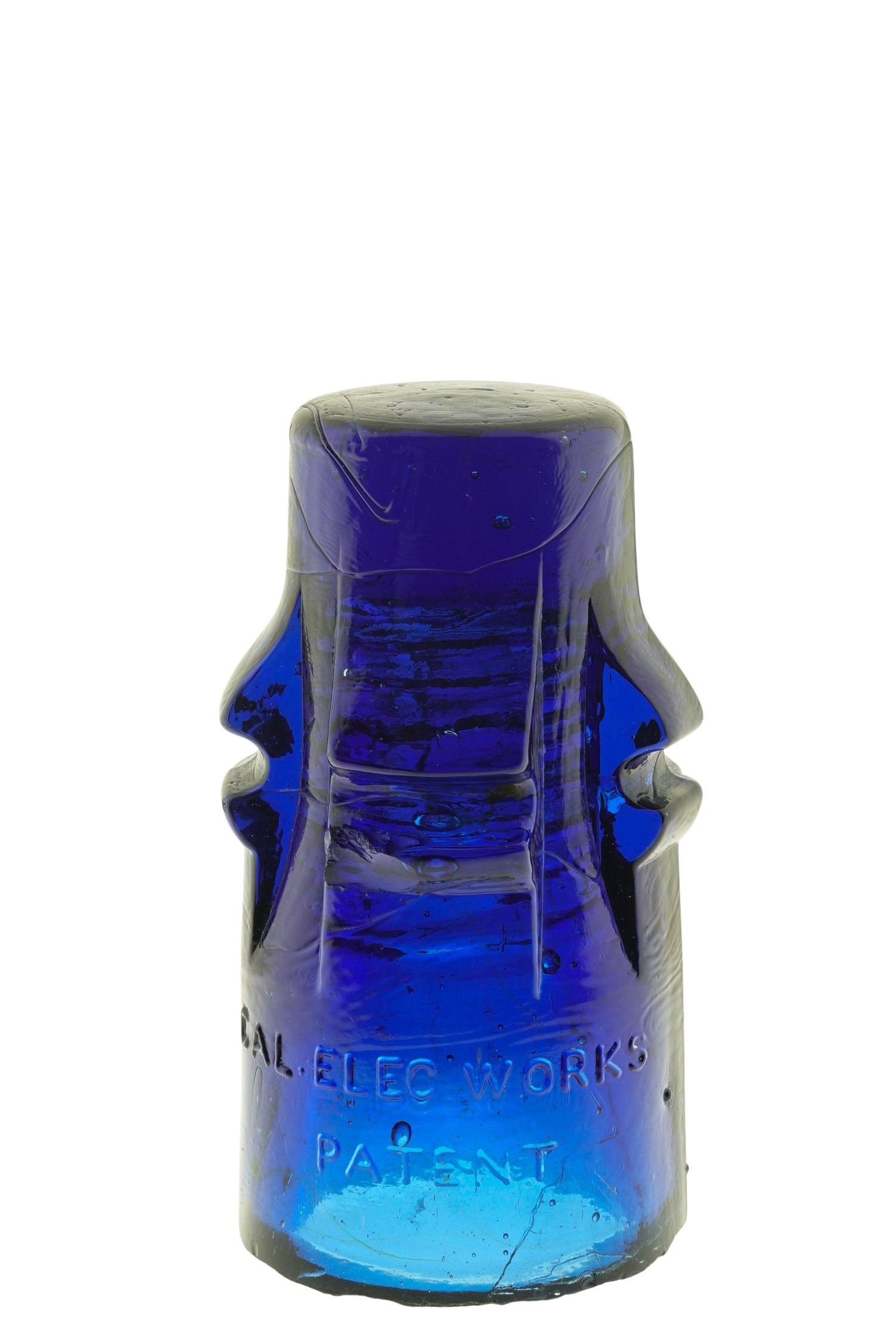
Cal Electric Works Insulator
Circa 1877–1880s, CD 130.1, 4 1/2". California Electrical Works was organized in 1877 as the successor to the Electrical Construction & Maintenance Company (EC&M), one of the pioneering telegraph supply firms on the West Coast. Operating from San Francisco, the company played an important role in the expansion of telegraph and electrical infrastructure throughout California and the Pacific Coast. The CD 130.1 is believed to have been used on one of California's earliest long distance telephone lines. Constructed in the late 1870s by the Ridge Telephone Company, the line connected French Corral and French Lake in the Sierra Nevada and provided telephone service for the region's hydraulic mining operations. Widely regarded as the most desirable insulator produced by California Electrical Works and one of the premier insulators of any type, it is highly prized by collectors throughout the country. This represents an important opportunity to acquire one of the hobby’s most celebrated insulators.
Description & Condition: A rich, deep cobalt blue. The skirt is in excellent condition. Two of the four fluted wire groove sections are relatively clean, with only a few small chips measuring approximately 1/8". Each of the other two sections has a chip measuring roughly 3/8". Overall, a very good example of this notoriously damage prone form.
Min. Bid $3,000 - Est. $6,000–$12,000
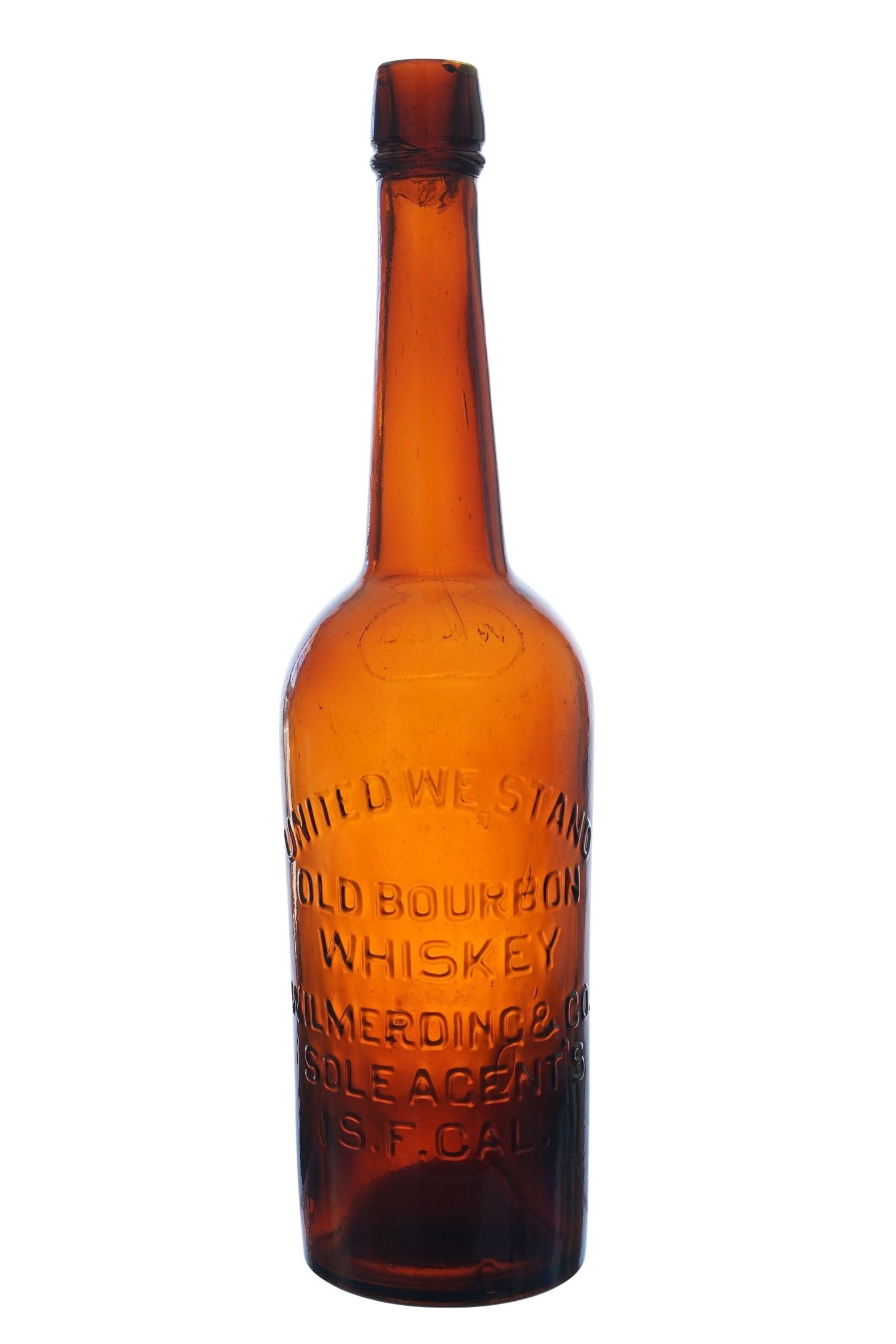
United We Stand Old Bourbon Whiskey Wilmerding & Co.
Circa 1878–1883, applied top, fifth. One of the more popular Western fifths, and for good reason. Beyond the patriotic name, it has been suggested that the brand may have been introduced in response to the national attention surrounding the assassination of President Garfield in 1881. While examples surface from time to time, there are still not enough to satisfy collector demand, with perhaps fewer than 10 examples known. A rare and highly desirable Western fifth with a great name and strong collector appeal.
Description & Condition: Amber color with a good strike. A solid example.
Min. Bid $1,250 - Est. $2,500–$5,000
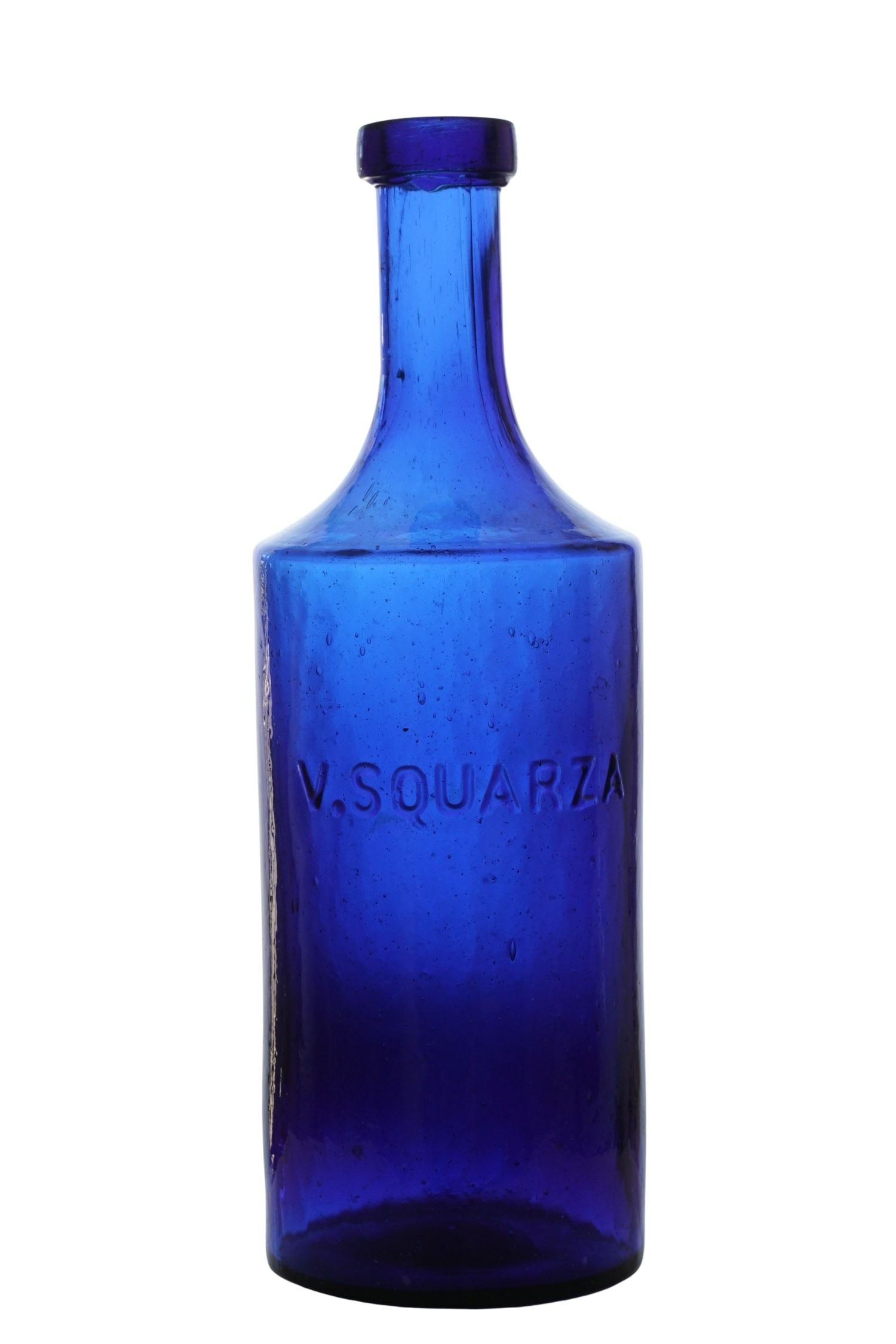
V. Squarza
Circa 1863–1866, applied top, 8 5/8". Vincenzo Squarza, an Italian immigrant, came to San Francisco in 1860 and established himself as a manufacturer and dealer of punches, cordials, and miscellaneous spirits. Squarza was best known for his popular "Squarza's Punch," though advertisements show he also marketed a Cholera Bitters in 1866. It is possible this bottle served as a generic container for any of his various products. Likely produced by Pacific Glass Works, it ranks among one of the earliest bottles blown in San Francisco, with only about five examples known today. Its unusual form sets it apart from virtually every other Western bottle of the period, and it is rare enough that most collectors have never had the opportunity to see one in person. It is also part of a very small group of known cobalt Western bottles from the 1860s that were used for products other than soda.
Description & Condition: Deep cobalt color with light whittle and early glass character. A small flake is present on the “Q,” along with minor abrasion to the side and top of the lip. The neck has a tiny potstone with an associated cluster of shallow, interconnected fissures just below the top, likely originating during manufacture. Overall, an impressive example with strong color and visual appeal.
Min. Bid $3,000 - Est. $6,000–$10,000
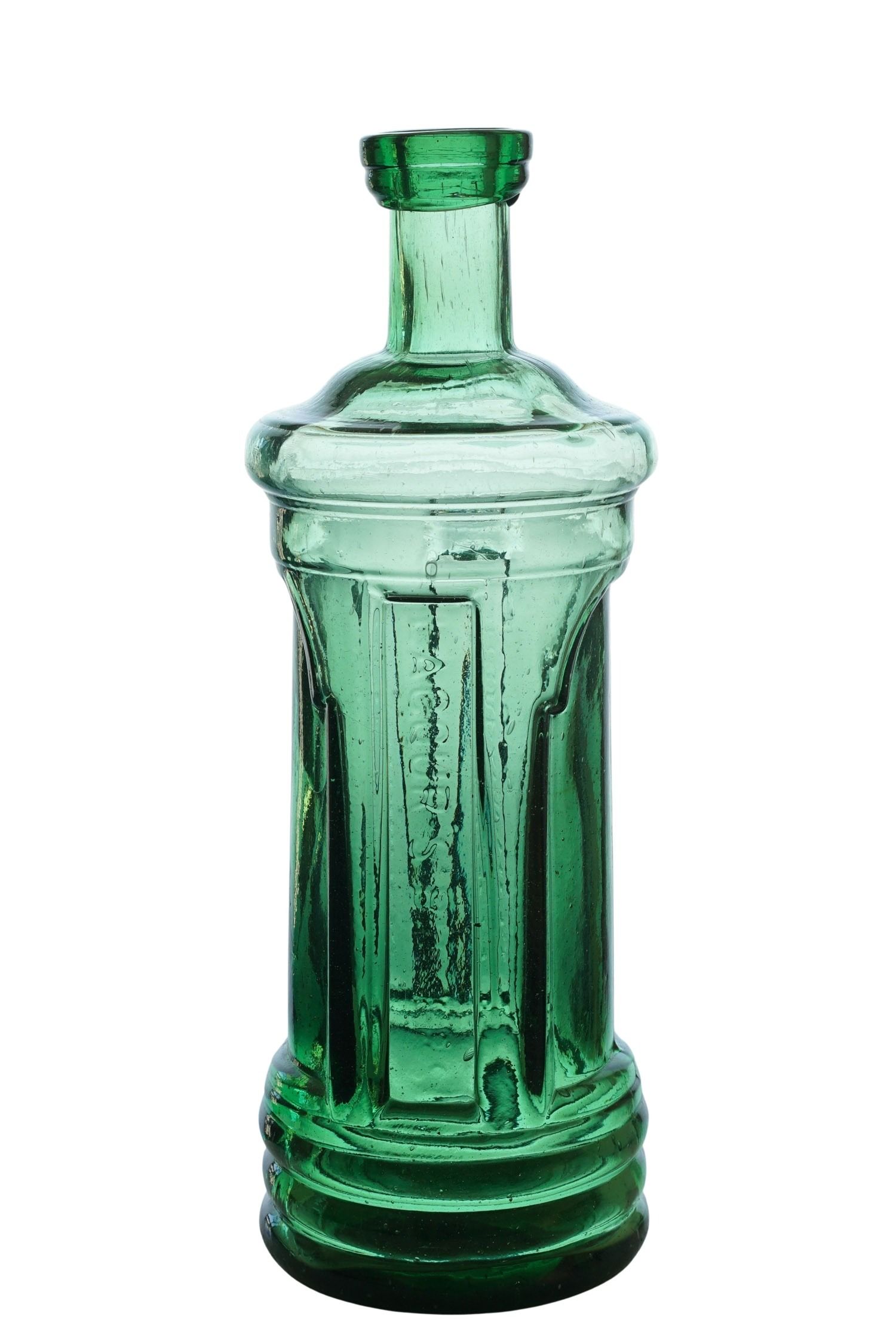
Lacour’s Sarsapariphere Bitters
Circa 1867–1869, smooth base, 9 1/4". Variant 1. An iconic Western bitters and one of the few figural bottles produced on the West Coast. Louis Lacour trademarked these bottles in 1867 in the shape of a lighthouse. The unusual name "Sarsapariphere" appears to have been a proprietary trade name associated with Lacour's sarsaparilla–based blood purifier, although the exact meaning and origin of the term remain unknown. There are three recognized variants of Lacour's bottles, this being the first variant. Long considered one of the most desirable of all Western bitters, the Lacour's is highly sought after by both Eastern and Western collectors alike. Collectors are particularly drawn to the vivid colors, crude glass, and distinctive figural form for which these bottles are known. With its early date and iconic design, it remains a cornerstone bottle in advanced collections.
Description & Condition: Vibrant apple green. Displays a large, shallow, partially open interior bubble, likely as made. A minuscule flake to the neck with an associated bruise measuring approximately 1/16", along with a minor 1/16" flea bite on the body, are the only notable issues. Remarkably, this example is otherwise free of the larger cracks, checks, bruises, and fissures commonly encountered on Lacour’s bottles. An exceptional example in fantastic condition and color.
Min. Bid $6,000 - Est. $12,000–$20,000
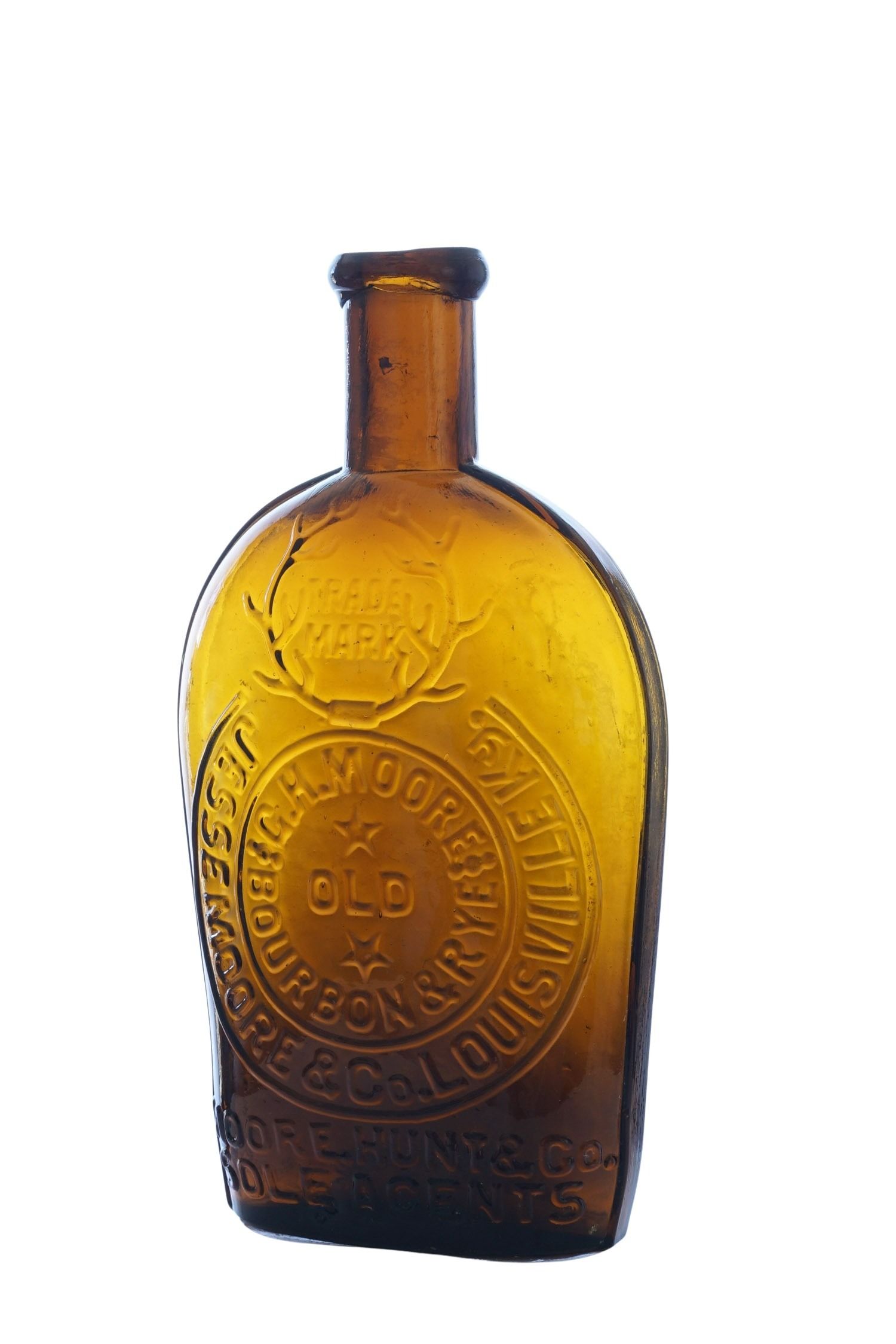
Jesse Moore Old Bourbon
Circa 1878–1882, applied top, pint. A highly desirable Western flask that matches the larger Jesse Moore fifth, featuring the same bold embossed antlers and extensive full–face embossing. Examples are known in a variety of amber shades and occur with both single and double roll tops, with the single roll examples being the scarcer of the two variants. Like the fifths, these flasks enjoyed a broad distribution and have been found throughout California, Nevada, and even as far north as Washington. Though not the rarest Western flask, they are consistently in high demand and remain a staple in any advanced flask collection.
Description & Condition: Medium amber. Desirable single roll top with a strong strike and some attractive crudity. Tiny fleabite to the base edge, light shovel scuffs on the reverse, a 1/16" bruise on the front near the base, and a minor amount of interior stain on the reverse. All minor issues, a great example.
Min. Bid $1,500 - Est. $3,000–$5,000
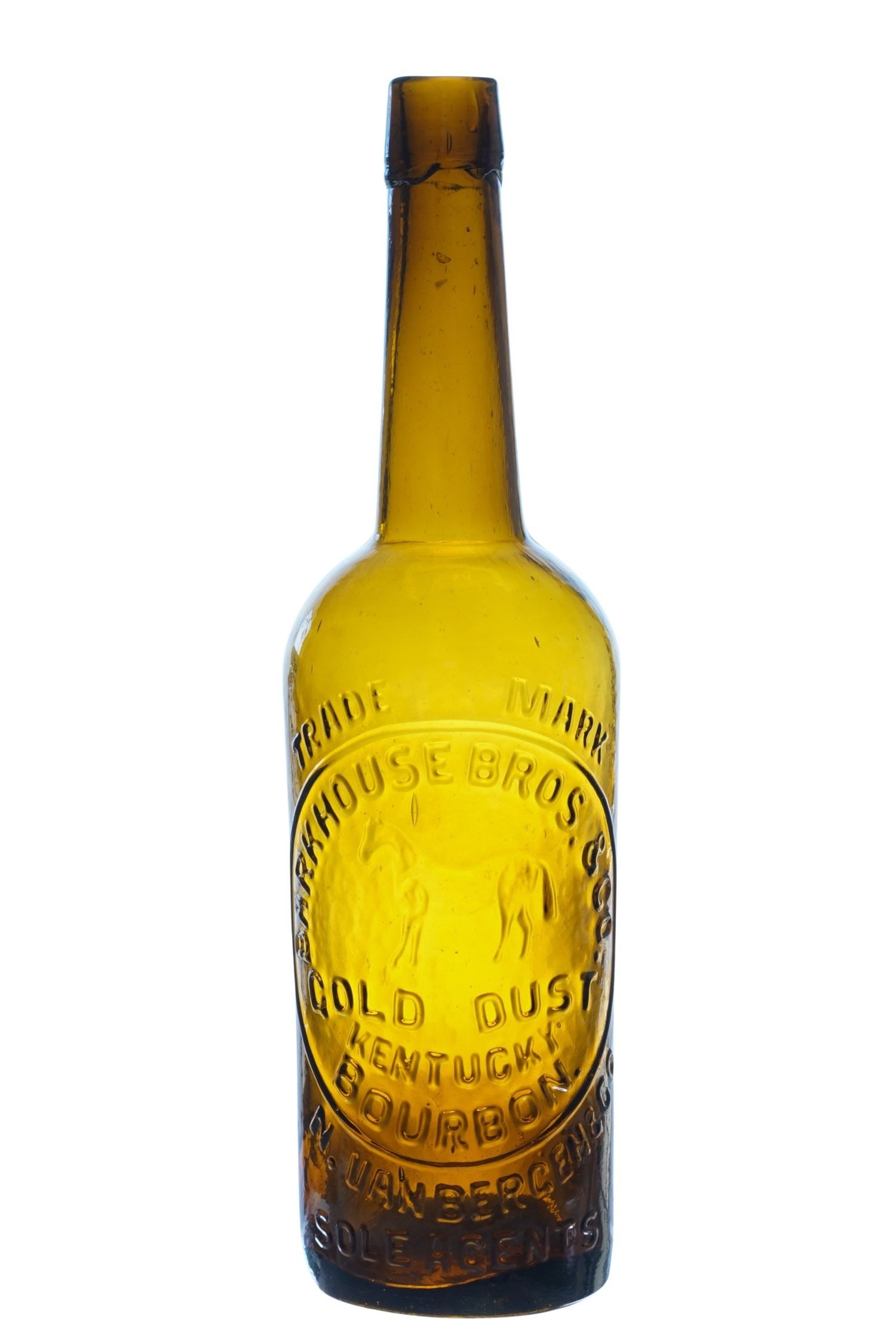
Gold Dust Kentucky Bourbon N. Van Bergen Sole Agents
Circa 1874–1880, applied top, fifth. This is the second variant of the Gold Dust 5th, made after Nicholas Van Bergen took over the company in 1874. There are similar amounts of Johns and Ns, but the N remains slightly rarer. This example was in the famous Ken Schwartz collection for several years before Jeff purchased it a few years ago. An outstanding example loaded with whittle in a beautiful yellow olive color with an unusually small and crude top.
Description & Condition: Honey olive color with a strong strike and abundant whittle. An exceptional example, formerly in the famed Ken Schwarz collection.
Min. Bid $4,000 - Est. $8,000–$15,000
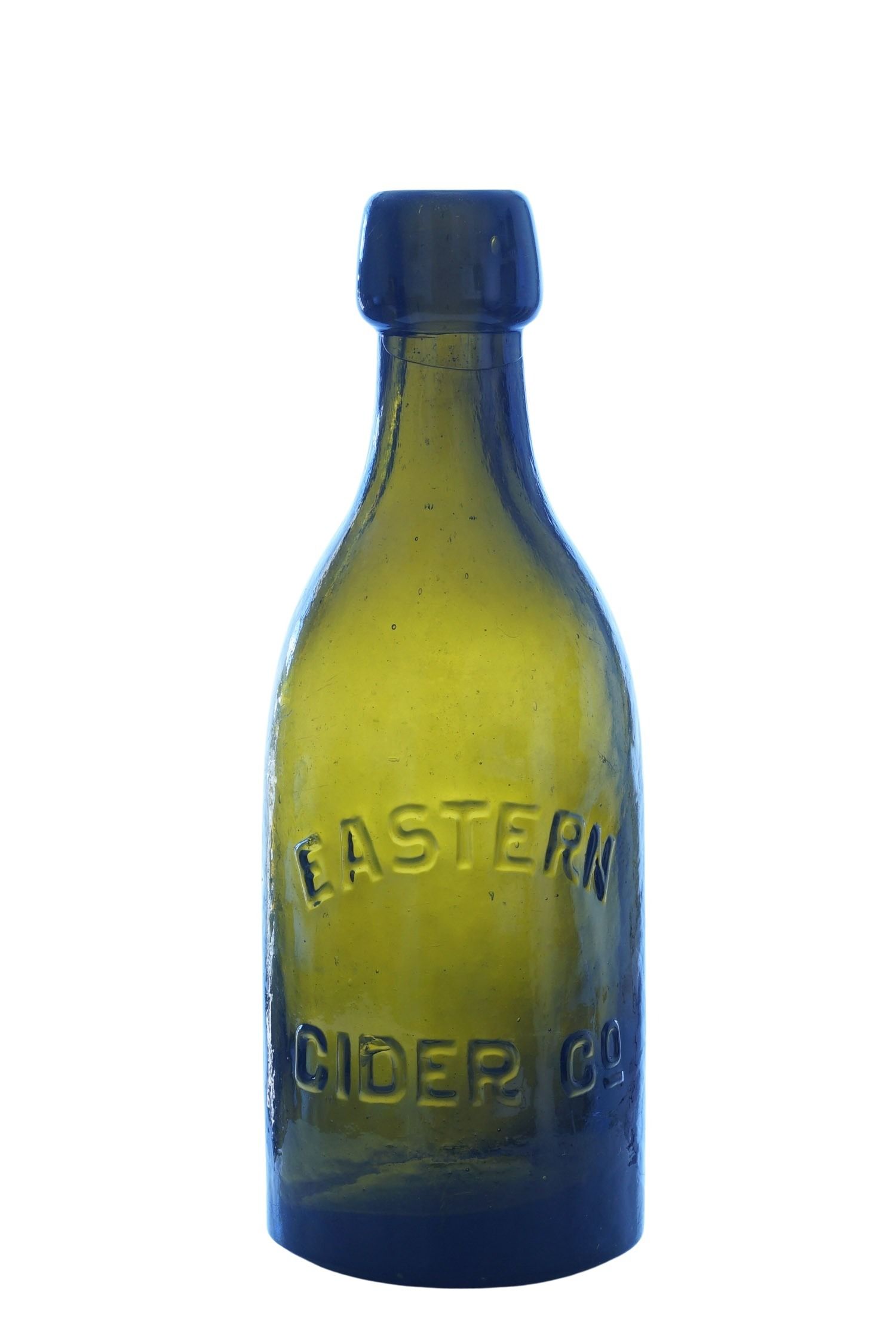
Eastern Cider Co.
Circa 1876–1880s, applied top. A popular Western soda and one of the few known Western sodas found in colors outside the typical aqua, green, and blue spectrum. While Eastern ciders occur in virtually every shade of amber, from yellow to olive green, undamaged olive or green examples are exceedingly uncommon. This is one of the greenest examples known and was personally dug by Jeff in a creek near Aptos in 1969. Fortunately, he was able to reacquire it later in life, adding an interesting provenance to an already exceptional bottle. Most of the known green examples suffer from some form of damage, usually cracks or checks.
Description & Condition: Outstanding olive green with good whittle and a pronounced front drip. One of the greenest Eastern Ciders known. Minor areas of glass loss on the E in Eastern and the D in Cider, both insignificant. Combining color, condition, and provenance, this example would be a highlight in any advanced Western soda collection.
Min. Bid $2,000 - Est. $4,000–$8,000
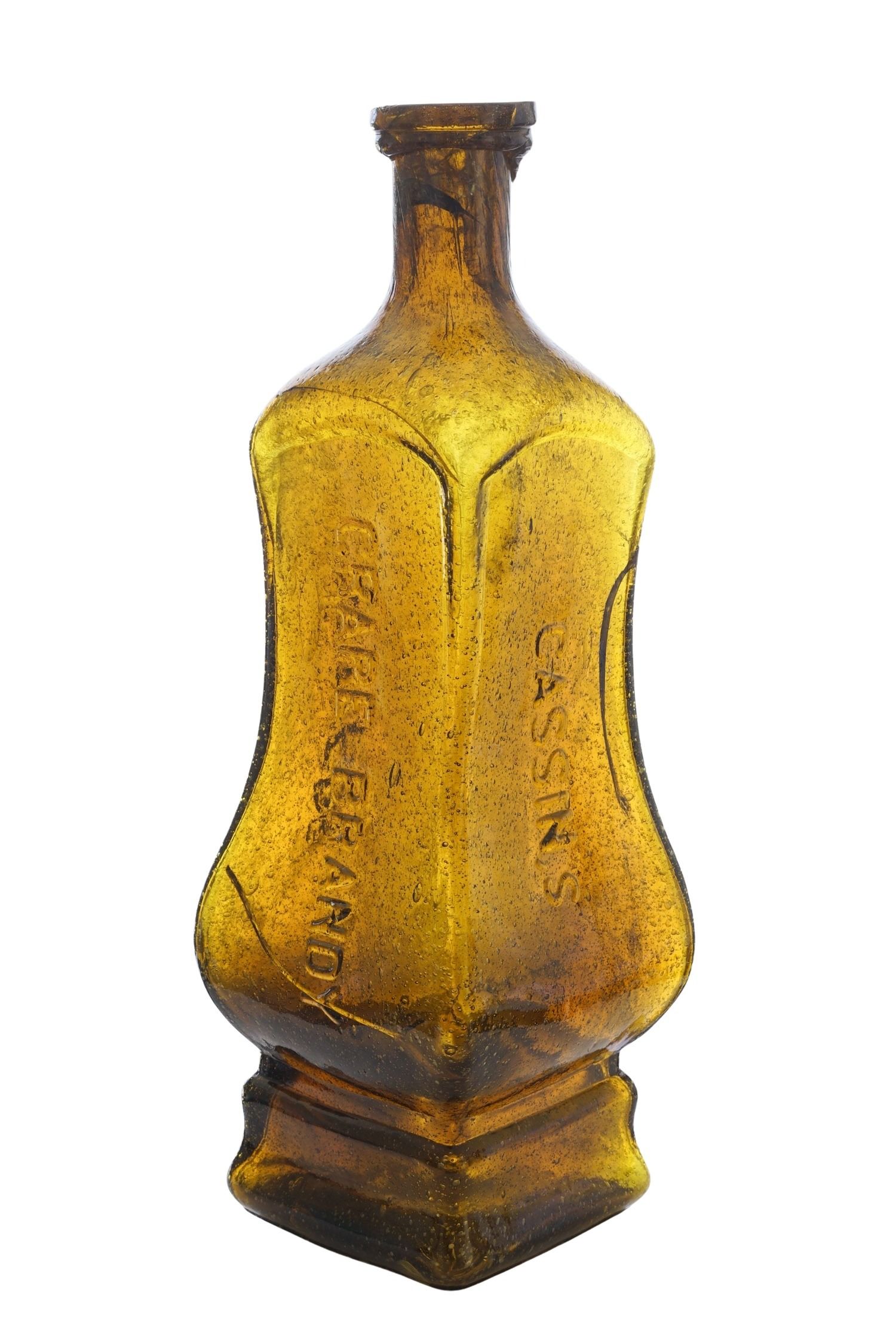
Cassin's Grape Brandy Bitters
Circa 1867–1868. Variant 2. A bottle that hardly needs an introduction. These legendary figural bitters were produced in San Francisco by Francis and Patrick Cassin, early California merchants involved in the liquor and bitters trade. Coveted by collectors for their vivid colors, distinctive viola form, and often crude, character rich glass, Cassin's Bitters ranks among the most iconic bottles of the American West. Like many of San Francisco's rarest bottles, surprisingly few examples have been found in the city itself, with the majority of known examples discovered in California's Gold Country and Nevada. The bottles occur in two mold variants, with this example being a Variant 2. It is believed the deeper body panels found on Variant 1 made the bottle more prone to damage, resulting in the mold being redesigned into what collectors now recognize as Variant 2. This particular example is noteworthy as the most recently discovered Cassin's known to us, having been found beneath a tree in California's Gold Country just a few years ago. The second Jeff saw this bottle, he knew he had to own it.
Description & Condition: A beautiful example in a rich golden amber, loaded with thousands of trapped air bubbles. Several annealing checks are present, along with numerous manufacturing related stress cracks throughout the bottle. Although extensive, these are believed to have occurred during the manufacturing process rather than from post production damage. Regardless, it remains a truly stunning and incredible piece of early California glass.
Min. Bid $5,000 - Est. $10,000–$15,000
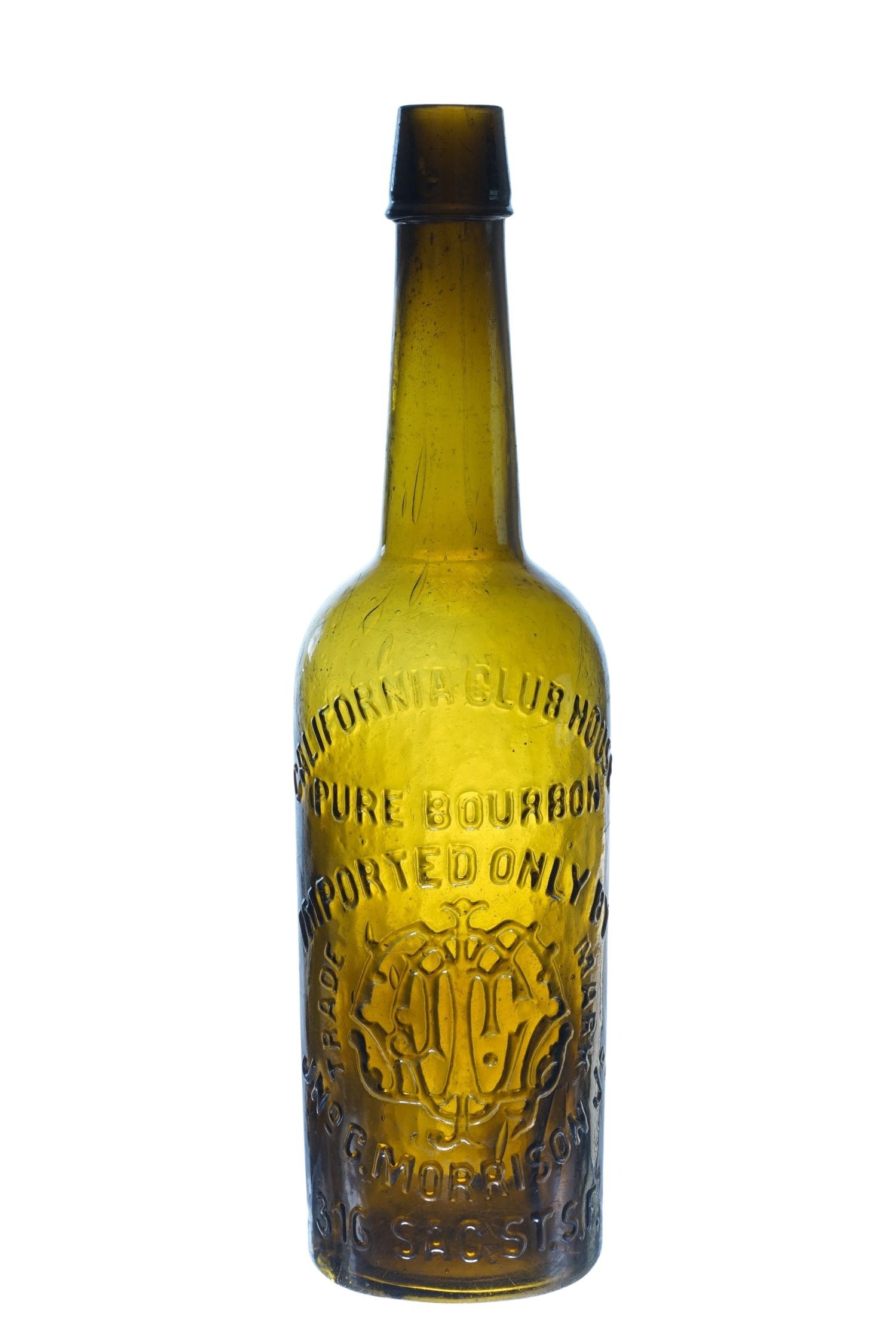
California Club House Pure Bourbon Imported Only By Jno C. Morrison 316 Sac. St. S.F.
Circa 1871–1873, applied top, fifth. John C. Morrison Jr. was one of California's early pioneers arriving in San Francisco in June 1849 during the Gold Rush. He briefly mined at Horseshoe Bar before moving to Sacramento and eventually returning to San Francisco, where he established himself in the liquor trade during the 1860s. By 1872, Morrison was advertising his California Club House brand. Although rare, these bottles enjoyed a wide distribution and have been found in San Jose, Marin County, Portland, and, of course, Nevada, where multiple examples have been discovered. After more than 60 years of searching, bottle collectors can account for only about ten examples. Considered by many to be the finest Western whiskey fifth, owing to its head-to-toe embossing, iconic name, early age, and highly coveted street address. There are believed to be about 5 amber, 3 green, and 2 olive examples known. This is the famous example once owned by the legendary John Thomas, who purchased it from Frank Shoengarth shortly after Frank dug it in Columbus, Nevada, in 1970. Frank had dug two olive examples: this example and another that was missing its neck and was later repaired.
Description & Condition: Olive amber with heavy whittle and an outstanding strike. Moderate scratching and scattered surface impacts, likely the result of spending nearly a century in the Nevada desert. Includes a small 1/16" impact with minor glass loss on the C in C. Morrison, along with a few other harmless surface impacts measuring approximately 1/32" to 1/16". While not perfect, it is about as well preserved as one could reasonably expect for a bottle that survived the rigors of the Wild West before lying buried in the Nevada desert for nearly a century.
Min. Bid $5,000 - Est. $10,000–$20,000